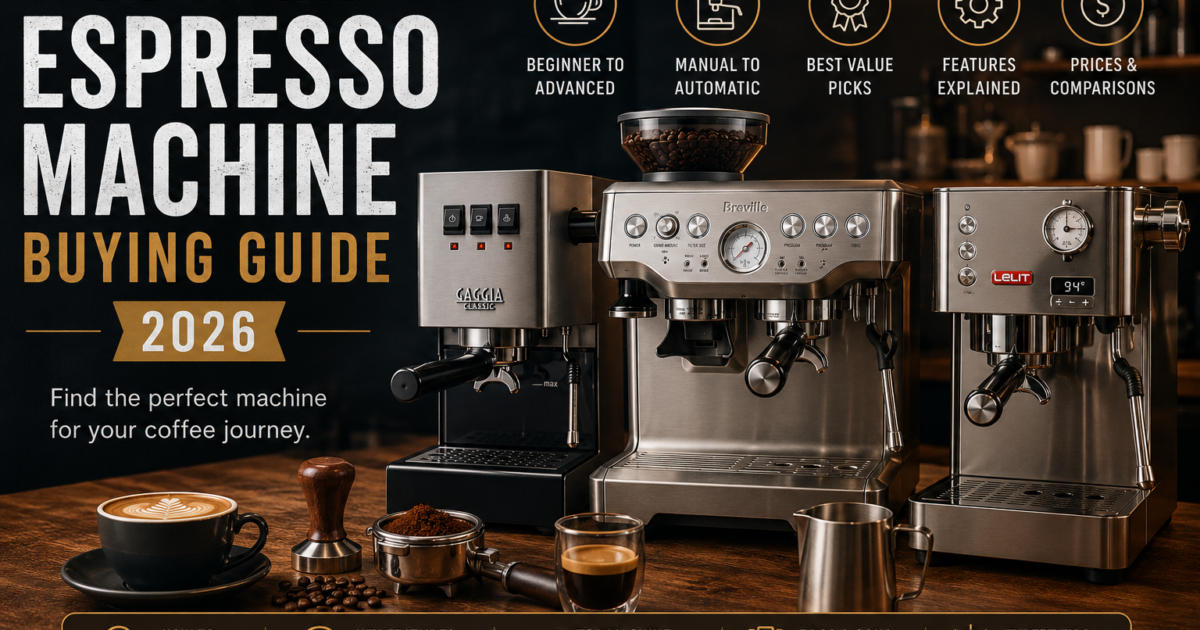
The Complete Espresso Machine Buying Guide (2026)
Everything you need to know before buying an espresso machine — boiler types, budget tiers, features that matter, and which machine fits your setup.
Buying your first espresso machine involves more decisions than it should. Boiler type, PID controllers, portafilter size, built-in grinders, single vs. dual boiler — it’s a lot of terminology thrown at you before you’ve pulled a single shot. This guide cuts through it. We’ll walk through exactly what matters, what doesn’t, and how to match a machine to how you actually drink coffee, with links to every relevant review and tool along the way.
What’s in this guide
How to Set a Budget
The honest starting point isn’t “what machine should I buy” — it’s “what’s this actually going to cost me over a year.” An espresso machine’s sticker price is only part of the total: factor in a grinder if one isn’t included, fresh beans, a tamper, and a scale if you don’t already own one. Most first-time buyers land somewhere between $300 and $700 all-in, which is enough to get a genuinely capable setup without paying for prosumer features you won’t use for a while.
Not sure it’s worth it yet? See exactly how much you’d save vs. buying café coffee, and how long it takes a machine to pay for itself.
If you’re on the fence about whether home espresso is for you at all, it’s worth erring toward the lower end of your budget range for your first machine. You’ll learn what you actually want from a second machine far faster than you can predict it up front.
Single vs. Dual Boiler, Explained
This is the single spec that causes the most confusion, so here’s the short version: a single boiler machine uses one boiler for both brewing and steaming, which means you switch modes and wait between pulling a shot and steaming milk. A heat exchanger machine uses one boiler but routes water through a separate internal tube for brewing, so you can steam and brew closer together without a full mode switch. A dual boiler machine has two fully separate boilers, so it can brew and steam at the exact same time with no compromise to either.
In practice: if you make milk drinks back-to-back for multiple people, a dual boiler is a real daily convenience. If you mostly drink straight shots, or make one drink at a time, a single boiler saves you money without costing you much in practice.
Still not sure which one fits how you brew? Answer 3 quick questions and we’ll point you to the right boiler type.
For the full breakdown with examples from machines we’ve tested, see our dedicated Single Boiler vs. Dual Boiler guide.
Key Features That Actually Matter
Temperature stability (PID controllers)
Inconsistent temperature is the most common cause of inconsistent shots — not grind size, not tamping pressure. A PID controller actively manages boiler temperature within a narrow range instead of letting it drift, which is why it shows up on nearly every prosumer machine’s spec sheet. If a machine doesn’t have one, that’s not automatically a dealbreaker, but it does mean more variance shot to shot.
Portafilter size
Most entry-level machines use a proprietary 51-54mm portafilter; most commercial-style machines (including several we’ve reviewed) use a standard 58mm portafilter. The 58mm standard matters mainly if you think you’ll eventually want to buy aftermarket baskets, bottomless portafilters, or upgrade parts — it’s a far larger accessory ecosystem.
Pre-infusion
A brief low-pressure soak before full brewing pressure kicks in, which helps the puck saturate evenly and reduces channeling (water finding an easy path through the grounds instead of extracting evenly). Worth having, not worth paying a huge premium for on its own.
Build materials
Stainless steel bodies and brass/steel internals last longer and hold heat more consistently than machines built mostly from plastic. This is often where the price difference between two similarly-specced machines is actually going.
Budget Tier Breakdown
Entry Level $300 – $500
Genuinely capable machines here, usually single boiler, often without a built-in PID. This tier is about proving to yourself that you’ll actually use the thing daily before spending more.
Reviewed pick: Gaggia Classic Pro
All-in-One / Guided $500 – $800
This tier is dominated by machines that bundle a grinder and more automation, trading some build quality and upgrade path for a faster path to a decent daily shot.
Reviewed pick: Breville Barista Express — see also our Gaggia vs. Breville comparison
Prosumer Single/Dual Boiler $1,000 – $2,500
Real PID control, better temperature stability, sturdier builds, and in many cases dual boiler operation. This is where most serious home baristas eventually land.
Reviewed picks: Rocket Espresso Appartamento · Profitec Pro 600
Enthusiast / Near-Commercial $3,500+
Commercial-grade internals brought into a home-sized footprint. Diminishing returns on shot quality alone, but a real step up in consistency, build life, and steam power.
Reviewed picks: La Marzocco Linea Mini · La Marzocco Linea Micra · La Marzocco GS3 — see our full La Marzocco lineup comparison
Built-In Grinder vs. Separate Grinder
If your machine doesn’t include a grinder, treat a grinder as part of your total budget, not an optional add-on — pre-ground coffee goes stale within days and can’t be tuned to your machine, which makes it very difficult to pull a consistent shot no matter how good the machine is.
A built-in grinder (like on the Breville Barista Express) is a reasonable choice for beginners: it’s pre-matched to the machine and it’s one less thing to research. A separate grinder gives you more control and a clearer upgrade path — you can improve your grinder independently of your machine, which matters more the longer you stay in the hobby. See our grinder recommendations and burr vs. blade breakdown for more.
Common Mistakes First-Time Buyers Make
Want a direct recommendation instead of researching every tier yourself? Answer 5 quick questions about your budget, space, and experience level.
Where to Go From Here
Start by getting honest about your budget (including a grinder) and how you actually drink coffee day to day — that alone rules out most of the wrong machines for you. From there, browse our tier picks above or full Best Espresso Machines roundup, and use the Finder Quiz if you want a direct recommendation instead of comparing specs yourself.
Frequently Asked Questions
How much should I spend on my first espresso machine?
Most first-time buyers land somewhere between $300 and $700, which is enough to get a genuinely capable machine without paying for prosumer features you won’t use yet. If you’re not sure you’ll stick with home espresso, start at the lower end of that range rather than the higher end.
Do I need a separate grinder?
For espresso specifically, yes, in almost every case. Pre-ground coffee goes stale within days and can’t be adjusted to your machine, which makes it very difficult to get a good shot. Some machines include a built-in grinder, which is a reasonable option for beginners; if your machine doesn’t include one, budget for a dedicated burr grinder as part of your total cost, not as an optional extra.
Is a dual boiler machine worth the extra cost?
It depends on how you drink coffee. If you regularly make milk drinks back-to-back for multiple people, a dual boiler’s ability to brew and steam at the same time is a real, daily convenience. If you mostly drink straight shots or make one drink at a time, a single boiler or heat exchanger machine will save you money without costing you much in practice.
What’s the single most important feature to prioritize?
Temperature stability matters more than almost any other spec, because inconsistent temperature is the most common cause of inconsistent shots. This is what features like PID controllers and thicker boilers are actually solving for, more than any single marketed feature.
Some links on this site are affiliate links. We may earn a small commission at no extra cost to you.