How to Descale an Espresso Machine: Step-by-Step Guide (2026)
Why Descaling Matters
Scale is the silent killer of espresso machines. Every time water heats inside your boiler or thermocoil, dissolved minerals—primarily calcium and magnesium—precipitate out and form hard, chalky deposits. These deposits cling to heating elements, clog narrow water passages, and coat temperature sensors. Over time, scale buildup does three things: it reduces heating efficiency (your machine works harder and uses more energy), it throws off brew temperature (scale insulates sensors from actual water temp), and it restricts water flow (narrower passages mean lower pressure at the group head).
Left unchecked, severe scale can permanently damage a machine. Heating elements overheat and burn out. Solenoid valves seize. Boilers develop pinhole leaks. These are expensive repairs—often exceeding the value of an entry-level machine. Descaling isn’t optional maintenance. It’s the single most impactful thing you can do to extend your machine’s lifespan.
This guide covers everything you need to know about how to descale an espresso machine safely, regardless of brand or boiler type. For broader maintenance routines beyond descaling, visit our espresso machine maintenance hub.
How Often You Should Descale
There is no universal descaling schedule. Frequency depends entirely on your water hardness and machine usage. A machine pulling 4 shots daily with hard water needs descaling far more often than one pulling 2 shots with soft water. The table below gives a practical baseline.
| Water Hardness (ppm / °dH) | Example Regions | Descaling Frequency |
|---|---|---|
| Soft (0-60 ppm / 0-3 °dH) | Seattle, Vancouver, Scotland | Every 6-9 months |
| Moderately Hard (60-120 ppm / 3-7 °dH) | New York, Chicago, London | Every 3-4 months |
| Hard (120-180 ppm / 7-10 °dH) | Los Angeles, Phoenix, Berlin | Every 2-3 months |
| Very Hard (180+ ppm / 10+ °dH) | Las Vegas, Madrid, rural limestone areas | Every 4-6 weeks |
Don’t guess your water hardness. Test strips cost under $10 for a pack of 100. Most machine manufacturers include them with new machines. If you’re using filtered or bottled water, check the label—many “spring waters” are surprisingly hard. Distilled and reverse osmosis water should never be used alone (they’re corrosive to metals and don’t conduct level sensors properly), but remineralized RO water formulated for espresso is ideal and dramatically reduces descaling frequency.
Signs you’re overdue for descaling: Machine takes longer to heat up, steam pressure feels weaker than normal, brew water temperature fluctuates shot to shot, or you hear a hissing/rattling sound from inside the machine during warm-up.
What You’ll Need
- Descaling solution — Use the manufacturer-recommended product (Gaggia Decalcifier, Breville Descaling Powder, Dezcal, etc.). Generic citric acid solutions work for stainless steel boilers but are too aggressive for aluminum.
- Fresh water — For the initial solution mix and extensive flushing afterward.
- Large container — At least 1.5-2L capacity to catch flush water. A mixing bowl or large measuring cup works.
- Blind basket (optional) — For backflushing during the descale cycle on machines with three-way solenoid valves.
- Clean cloth — For wiping drips and cleaning the group head exterior afterward.
⚠️ Critical Warning: Aluminum Boilers
Machines with aluminum boilers—including the Gaggia Classic Pro—require specific descaling solutions. Standard citric acid or vinegar-based descalers will pit and corrode aluminum, potentially ruining your boiler. Always use an aluminum-safe descaler like Gaggia’s own formula or Durgol Swiss Espresso. If you’re unsure of your boiler material, check your machine’s manual or look it up before proceeding.
Step-by-Step Descaling Process
This process works for virtually all single-boiler and dual-boiler home espresso machines with a vibratory pump. Plumbed-in commercial machines require a different approach—see the machine-specific section below.
-
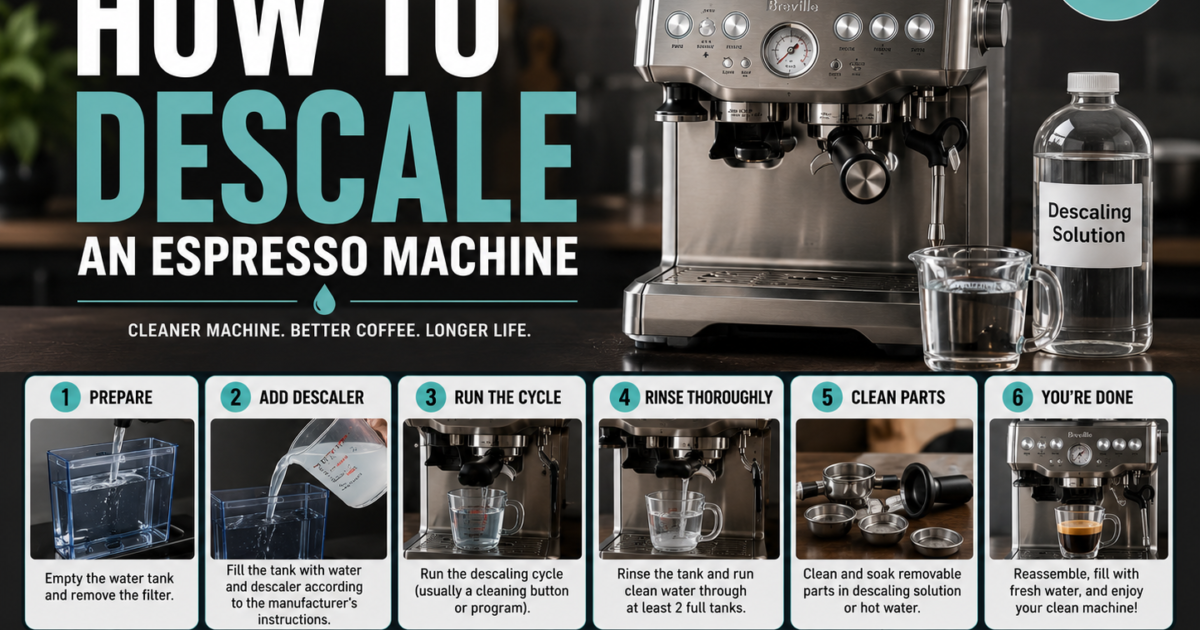
Empty and rinse the water reservoir
Remove the reservoir, discard any remaining water, and rinse thoroughly. Remove any in-tank water filters before descaling—descaling solution can damage filter cartridges. Set the filter aside and reinstall it fresh after the cycle.
-
Mix the descaling solution
Follow your descaler’s instructions precisely for water-to-solution ratio. More is not better. Over-concentrated solution is harsh on seals and gaskets. Pour the mixed solution into the empty reservoir.
-
Run solution through the brew circuit
Place a large container under the group head. Run the pump in 30-second intervals, pausing for 30 seconds between each. This allows the solution to sit inside the boiler and dissolve scale. Repeat until approximately half the reservoir has been pumped through. Do not engage the portafilter—run water freely from the group.
-
Run solution through the steam circuit
After half the solution is gone, switch to steam mode. Open the steam wand over your container and let the steam boiler discharge solution. On single-boiler machines, this also flushes the steam thermostat pathway. Run until the solution level drops significantly. Switch back to brew mode.
-
Run solution through the hot water spigot (if equipped)
If your machine has a separate hot water tap (common on dual-boiler machines like the Breville series and the Profitec Pro 600), dispense hot water until about 200ml has flowed. This clears the hot water pathway.
-
Let the solution soak
Turn the machine off. Let the remaining descaling solution sit inside the boiler and internal lines for 15-20 minutes. This dwell time is critical—it’s when the descaling agent actually dissolves the mineral deposits. Don’t skip this step.
-
Flush with fresh water — thoroughly
Empty and rinse the reservoir completely. Fill it with fresh, clean water. Run the pump in long intervals to flush all traces of descaling solution from the brew circuit, steam wand, and hot water spigot. Flush until the reservoir is empty, then refill and flush again. Do this at least twice. Residual descaler in your boiler will taint coffee flavor for days.
-
Reinstall the water filter and test
Install a fresh in-tank water filter. Pull a blank shot (no coffee) and taste the water. It should be completely neutral—no chemical taste, no metallic aftertaste. If you taste anything, keep flushing. Once clean, pull a seasoning shot with old coffee to re-coat the group screen before brewing your actual drink.
Machine-Specific Notes
Single Boiler Machines (Gaggia Classic Pro, Rancilio Silvia, ECM Casa V)
Single boilers are the most straightforward to descale because there’s only one water circuit. The key concern is boiler material. The Gaggia Classic Pro uses an aluminum boiler—use only aluminum-safe descalers. The Rancilio Silvia uses brass, which tolerates a wider range of solutions. Single boiler machines also need more careful flushing because the boiler capacity is smaller and descaler concentration stays higher. Our full Gaggia Classic Pro review includes specific descaling guidance for that model.
Dual Boiler Machines (Profitec Pro 600, Lelit Bianca, ECM Synchronika)
Dual boiler machines have two separate water circuits that both need descaling. The brew boiler and steam boiler are isolated, so you need to run solution through both independently. The steam boiler is typically much larger and takes longer to flush completely. On rotary pump machines, the process is faster because flow rates are higher. Important: Some dual boilers have a descaling mode built into the PID controller that automates the dwell times. Check your manual before using the generic process. Our Profitec Pro 600 review covers the specific descaling mode for that machine.
Plumbed-In Machines and High-End Home Models (La Marzocco Linea Mini, GS3)
Plumbed-in machines are not designed for reservoir-based descaling. On the La Marzocco Linea Mini and GS3, La Marzocco recommends against DIY descaling entirely. These machines use large commercial boilers with significant water volume, and incomplete flushing leaves descaler residue that’s difficult to fully remove without disassembly. La Marzocco’s official guidance is to use properly formulated water from the start (remineralized RO) and have a technician perform any necessary descaling during scheduled maintenance. The cost of preventative water treatment is far less than the cost of boiler repair. Learn more in our La Marzocco lineup guide.
Thermocoil Machines (Breville Barista Express, Breville Bambino)
Thermocoil machines don’t have a traditional boiler. Water is flash-heated as it passes through a heated metal coil. Descaling is still necessary—minerals deposit on the coil surfaces just like a boiler—but the process is typically faster because there’s less water volume. Breville machines have a built-in descaling cycle that automates the timing. Use Breville’s branded descaling powder, as generic solutions may not be optimized for thermocoil materials. See our Breville Barista Express review for activation instructions.
Common Mistakes to Avoid
🚫 The Most Common Descaling Errors
- Using vinegar. Vinegar is acidic and will descale, but it’s also corrosive to rubber gaskets and leaves a lingering odor that takes days of flushing to remove. Commercial descaling solutions are cheap. Use them.
- Skipping the dwell time. Flushing solution straight through without letting it sit in the boiler dissolves almost nothing. The chemical reaction takes time. Minimum 15 minutes.
- Using the wrong descaler for your boiler material. Citric acid on aluminum destroys boilers. Lactic acid on certain brass alloys leaches metals. Read your manual.
- Forgetting to remove the in-tank water filter. Descaling solution saturates the filter media and ruins it. You’ll need to replace it afterward anyway, but leaving it in also reduces solution concentration.
- Inadequate flushing. Residual descaler in the boiler means your next several shots will taste metallic and chemically. Flush at least two full tanks of fresh water. Taste-test the output before brewing coffee.
- Descaling too frequently. More is not better. Over-descaling with harsh solutions can accelerate gasket wear. Stick to the schedule your water hardness dictates, not a monthly habit out of anxiety.
- Running the steam wand dry. Always ensure the wand tip is submerged or directed into a container before opening the steam valve during descaling. Hot descaler spraying unpredictably is a burn risk.
Frequently Asked Questions
Q: Can I use vinegar to descale my espresso machine?
A: We strongly advise against it. White vinegar is acidic enough to dissolve scale, but it attacks rubber gaskets and O-rings, and the odor persists through multiple flushes. Commercial descalers like Dezcal or Durgol cost under $10 per use and are formulated to be safe on all internal materials.
Q: How do I know if my machine has an aluminum boiler?
A: The Gaggia Classic Pro is the most common aluminum-boiler machine. Other entry-level machines sometimes use aluminum thermoblocks. Check your manual or manufacturer’s website. If it’s aluminum, the manual will specify which descaler to use. When in doubt, use a descaler labeled “aluminum safe.”
Q: Should I descale a brand new machine?
A: No. New machines are tested at the factory with water and arrive clean. Start your descaling schedule based on your water hardness from day one of use, not before.
Q: What water should I use to prevent scale buildup?
A: The ideal water for espresso is remineralized reverse osmosis (RO) water formulated to roughly 50-80 ppm total hardness with a balanced alkalinity. Brands like Third Wave Water or Perfect Cup Water add the right minerals back into distilled or RO water. This dramatically reduces scaling and eliminates the guesswork from descaling schedules. Never use pure distilled or RO water alone—it’s corrosive and can damage boilers.
Q: My machine has a “descale” warning light. Can I ignore it?
A: You can temporarily, but you shouldn’t long-term. The light is typically triggered by a shot counter, not an actual scale sensor, so it may come on before scale is severe. But it’s the manufacturer’s best estimate for your machine’s needs. Reset it after descaling according to the manual. Ignoring it repeatedly voids warranties and accelerates wear.
External Resources: For water chemistry standards and mineral content guidelines for espresso equipment, refer to the Speciality Coffee Association water quality handbook. Manufacturer-specific descaling instructions can be found at Whole Latte Love‘s support library.
Some links on this site are affiliate links. We may earn a small commission at no extra cost to you.