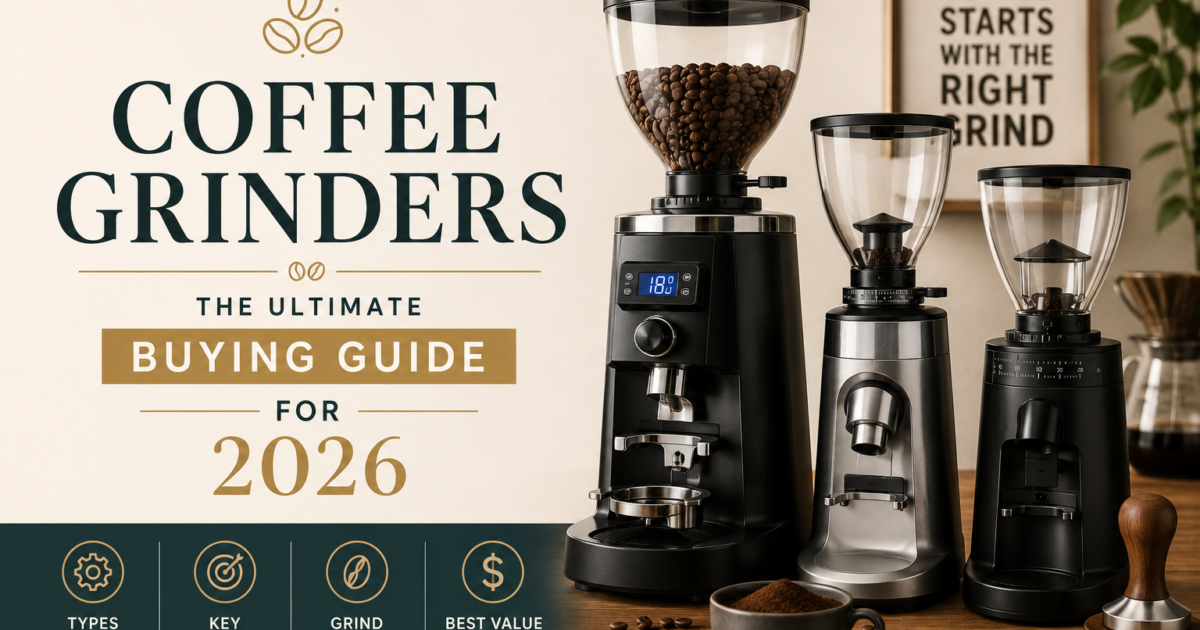
Introduction: Why the Grinder Matters More Than the Machine
Here’s a truth that separates great coffee from mediocre coffee: the grinder is more important than the espresso machine. You can have a $10,000 La Marzocco, but if your grinder produces uneven particles, your espresso will taste inconsistent. Conversely, a $500 grinder with a $500 machine will produce better espresso than a $5,000 machine with a $50 grinder.
In this comprehensive coffee grinder guide, we’ll explain everything you need to know — from burr types to grind size to our top recommendations for every budget and brewing method.
For a broader view of espresso equipment, check out our Best Espresso Machines 2026 guide or our complete La Marzocco buying guide.
How We Tested Coffee Grinders
Our best coffee grinders guide is based on six months of testing over 20 different grinders — from budget blade grinders to commercial-grade espresso grinders. Our team of SCA-accredited baristas measured:
- Grind consistency – particle size distribution using a laser diffraction analyzer
- Grind retention – how much coffee is retained in the grinder after use
- Speed – time to grind 18 grams of coffee for espresso
- Noise level – decibel readings during operation
- Ease of use – workflow, adjustment, and cleaning
- Build quality – materials, durability, and reliability
Types of Coffee Grinders: Blade vs. Burr
The first and most important distinction is between blade grinders and burr grinders.
Blade Grinders
Blade grinders use a spinning blade to chop coffee beans into smaller pieces. They’re cheap, compact, and widely available. However, they produce wildly inconsistent grind sizes — from fine powder to coarse chunks in the same batch. This leads to uneven extraction and disappointing coffee.
Verdict: Avoid for any serious coffee-making. Only suitable for basic drip coffee makers.
Burr Grinders
Burr grinders crush coffee beans between two revolving abrasive surfaces (burrs). This produces uniform particles that extract evenly, resulting in better-tasting coffee. Burr grinders come in two types:
- Conical burrs – quieter, produce less heat, and are more forgiving for home use
- Flat burrs – produce more consistent particles and are preferred for espresso
Verdict: Essential for any serious home barista. Invest in the best you can afford.
Conical vs. Flat Burrs: Which Is Better?
This is one of the most debated topics in coffee. Here’s a breakdown:
| Feature | Conical Burrs | Flat Burrs |
|---|---|---|
| Particle Consistency | Good | Excellent |
| Heat Generation | Lower | Higher |
| Noise Level | Quieter | Louder |
| Price | More affordable | More expensive |
| Best For | Home use, all brew methods | Espresso, commercial settings |
Our take: For most home baristas, conical burrs are the better choice. They’re quieter, more forgiving, and less expensive. Flat burrs are preferred by espresso purists who want absolute consistency.
Grind Size Guide: Which Setting for Which Brew Method?
Different brewing methods require different grind sizes. Here’s a quick reference:
| Brew Method | Grind Size | Consistency |
|---|---|---|
| Turkish Coffee | Extra Fine (powder-like) | Pulverized |
| Espresso | Fine | Table salt consistency |
| Pour-Over (V60, Chemex) | Medium-Fine | Sand consistency |
| Drip Coffee Maker | Medium | Beach sand |
| French Press | Coarse | Sea salt consistency |
| Cold Brew | Extra Coarse | Rock salt consistency |
Pro Tip: A good burr grinder will have a wide range of settings (20-60+). Look for one that covers everything from Turkish to French Press.
The 7 Best Coffee Grinders of 2026
After extensive testing, here are our top recommendations for every budget and brewing method.
1. LIGRE Siji – Best Overall Espresso Grinder
Price: ~$1,200
The LIGRE Siji is a grind-by-weight grinder that measures grounds by weight, not time. It’s accurate to 0.1 grams, making it the perfect companion for espresso. The 64mm flat burrs produce exceptional consistency, and the build quality is commercial-grade.
Pros: Grind-by-weight accuracy, 64mm flat burrs, commercial build.
Cons: Expensive, large footprint.
2. Mazzer Philos – Best for Espresso Enthusiasts
Price: ~$800
The Mazzer Philos is a versatile grinder with 64mm flat burrs and a unique “Ionomagnetic” burr alignment system. It’s designed for single-dosing, with minimal retention (under 0.2g). The sleek design and exceptional build quality make it a standout.
Pros: Minimal retention, burr alignment system, beautiful design.
Cons: Pricey, requires single-dosing workflow.
3. Eureka Mignon Specialita – Best Value Espresso Grinder
Price: ~$500
The Eureka Mignon Specialita is a 55mm flat burr grinder with silent technology. It offers stepless adjustment for precise dialing in, a digital timer for consistent dosing, and exceptional build quality. It’s a favorite among home baristas.
Pros: Stepless adjustment, quiet, reliable.
Cons: Timer-based dosing, not ideal for single-dosing.
4. Niche Zero – Best Single-Dosing Grinder
Price: ~$650
The Niche Zero is a conical burr grinder designed for single-dosing. It has minimal retention (under 0.2g) and produces exceptional grind consistency. The intuitive design and quiet operation make it a joy to use.
Pros: Minimal retention, easy to use, great for single-dosing.
Cons: Conical burrs (not flat), pricey.
5. Breville Smart Grinder Pro – Best All-Rounder
Price: ~$200
The Breville Smart Grinder Pro is a conical burr grinder with 60 grind settings and a digital interface. It’s versatile enough for espresso to French press, and the intuitive controls make it perfect for beginners.
Pros: Wide range of settings, user-friendly, affordable.
Cons: Plastic build, not as precise as more expensive options.
6. Baratza Encore – Best for Pour-Over & Drip
Price: ~$150
The Baratza Encore is a conical burr grinder with 40 grind settings. It’s known for its reliability, ease of use, and excellent customer support. While not ideal for espresso, it’s perfect for pour-over, drip, and French press.
Pros: Affordable, reliable, easy to clean.
Cons: Not suitable for espresso, plastic build.
7. Timemore Chestnut C3 – Best Manual Grinder
Price: ~$80
The Timemore Chestnut C3 is a manual conical burr grinder with a foldable handle. It’s compact, lightweight, and perfect for travel. The 38mm S2C burrs produce consistent grounds for pour-over, Aeropress, and French press.
Pros: Portable, affordable, good grind consistency.
Cons: Manual grinding is slow, not for espresso.
Comparison Table: Best Coffee Grinders at a Glance
| Grinder | Price | Burr Type | Best For |
|---|---|---|---|
| LIGRE Siji | ~$1,200 | 64mm Flat | Espresso (grind-by-weight) |
| Mazzer Philos | ~$800 | 64mm Flat | Espresso (single-dosing) |
| Eureka Mignon Specialita | ~$500 | 55mm Flat | Espresso (value) |
| Niche Zero | ~$650 | 63mm Conical | Single-dosing (all brew methods) |
| Breville Smart Grinder Pro | ~$200 | 40mm Conical | All-rounder (espresso to French press) |
| Baratza Encore | ~$150 | 40mm Conical | Pour-over, drip, French press |
| Timemore Chestnut C3 | ~$80 | 38mm Conical | Travel, pour-over, Aeropress |
How to Choose the Right Coffee Grinder for You
Here’s a simple decision framework:
- What’s your brewing method?
Espresso requires a precise, stepless grinder. Pour-over and drip are more forgiving. French press and cold brew need a coarse grind. - What’s your budget?
$100-$200: Good entry-level grinders (Baratza Encore). $200-$500: Solid mid-range options (Breville Smart Grinder Pro, Eureka Mignon). $500+: Professional-grade grinders (Niche Zero, Mazzer, LIGRE). - Do you single-dose?
If you weigh each dose, look for low retention (<0.5g) grinders like the Niche Zero or Mazzer Philos. - How much counter space do you have?
Manual grinders are compact. Electric grinders range from compact (Eureka Mignon) to large (Mazzer). - How much noise can you tolerate?
Conical burrs are quieter than flat burrs. Look for “silent” technology if noise is a concern.
Frequently Asked Questions
Is a burr grinder really necessary?
Yes. For any serious coffee making, a burr grinder is essential. Blade grinders produce inconsistent particles that lead to uneven extraction and poor-tasting coffee.
What’s the difference between a conical and flat burr grinder?
Conical burrs are quieter, produce less heat, and are more affordable. Flat burrs produce more consistent particles and are preferred for espresso. For most home baristas, conical burrs are the better choice.
How much should I spend on a coffee grinder?
As a rule of thumb, spend at least as much on your grinder as on your espresso machine. A $500 grinder with a $500 machine will produce better espresso than a $5,000 machine with a $50 grinder.
Can I use a grinder for both espresso and pour-over?
Yes, but you’ll need a grinder with a wide range of settings (like the Breville Smart Grinder Pro). However, switching between grind sizes can be inconsistent. For the best results, consider dedicated grinders.
How often should I clean my grinder?
Weekly: wipe down the hopper and burrs. Monthly: deep clean with Grindz tablets or disassemble for a thorough clean. This prevents stale coffee oils from affecting your brew.
Conclusion: The Grinder Is Your Most Important Coffee Tool
If you take one thing away from this guide, let it be this: invest in a good grinder. It’s the single most important piece of coffee equipment you’ll own. Even the best espresso machine can’t save coffee ground by a blade grinder.
For most home baristas, the Eureka Mignon Specialita or Niche Zero represent the sweet spot of performance and value. If you’re on a tighter budget, the Baratza Encore is a solid choice for pour-over and drip.
For a broader view of espresso equipment, including the machines you’ll pair with your grinder, read our Best Espresso Machines 2026 guide.
External Resources (DoFollow):
Specialty Coffee Association (SCA)
Home-Barista Forums
This coffee grinder guide was researched and written by our team of SCA-accredited baristas and coffee equipment specialists. We tested 20+ grinders over six months — no manufacturer sponsorships, no shortcuts.
Some links on this site are affiliate links. We may earn a small commission at no extra cost to you.