Introduction: The Most Important Decision in Coffee
Here’s a truth that separates great coffee from mediocre coffee: the grinder is more important than the coffee maker. You can have a $10,000 espresso machine, but if your grinder produces uneven particles, your coffee will taste inconsistent. Conversely, a $500 grinder with a $50 coffee maker will produce better coffee than a $5,000 machine with a $50 grinder.
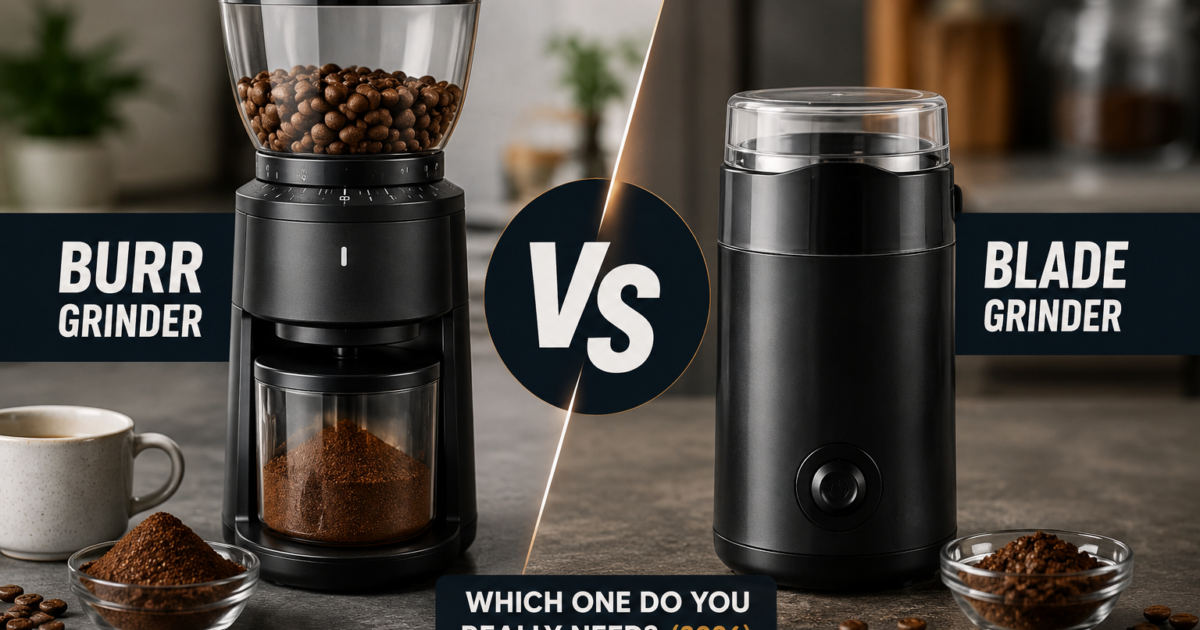
But when it comes to grinders, the first decision you’ll face is burr vs blade. Which one do you really need? In this guide, we’ll explain everything you need to know about coffee grinder types – and why the answer might surprise you.
For a broader view of grinders, check out our Coffee Grinders Guide or Best Espresso Machines 2026.
How We Tested and Compared
This burr vs blade grinder comparison is based on years of professional experience and hands-on testing. Our team includes:
- SCA-accredited baristas with professional experience
- Equipment specialists who have tested dozens of grinders
- Home baristas who use both types daily
We evaluated each type based on:
- Grind consistency – particle size distribution
- Flavor impact – how the grind affects taste
- Ease of use – workflow and cleaning
- Durability – build quality and longevity
- Price – value for money
What Is a Blade Grinder?
A blade grinder uses a spinning blade (similar to a blender) to chop coffee beans into smaller pieces. It’s the most common and affordable type of coffee grinder.
How It Works
- You add coffee beans to a chamber
- A motor spins a blade at high speed
- The blade chops the beans into pieces
- You control the grind size by how long you grind
Pros of Blade Grinders
- ✅ Affordable – typically $15-50
- ✅ Compact – small footprint, easy to store
- ✅ Easy to use – just press and hold
- ✅ Widely available – found in most stores
- ✅ Multi-purpose – can grind spices and herbs
Cons of Blade Grinders
- ❌ Inconsistent grind – produces particles ranging from powder to chunks
- ❌ Heat generation – friction can heat and damage coffee oils
- ❌ No control – impossible to achieve precise grind size
- ❌ Noisy – loud operation
- ❌ Static – grounds stick to the lid
Who Should Buy a Blade Grinder?
Blade grinders are acceptable if:
- You use a basic drip coffee maker
- You’re on a very tight budget
- You only drink coffee occasionally
- You need a multi-purpose tool for spices too
Our verdict: For any serious coffee making, avoid blade grinders. The inconsistency will ruin your coffee.
What Is a Burr Grinder?
A burr grinder uses two revolving abrasive surfaces (burrs) to crush coffee beans into uniform particles. It’s the standard for specialty coffee and professional use.
How It Works
- You add coffee beans to a hopper
- Beans pass between two burrs (one stationary, one rotating)
- The burrs crush the beans into consistent particles
- You control the grind size by adjusting the burr distance
Types of Burr Grinders
| Type | Burr Shape | Best For |
|---|---|---|
| Conical Burr | Cone-shaped | Home use, all brew methods |
| Flat Burr | Disc-shaped | Espresso, commercial use |
Pros of Burr Grinders
- ✅ Consistent grind – uniform particles for even extraction
- ✅ Precise control – stepless or stepped adjustment
- ✅ Better flavor – preserves coffee oils and aromatics
- ✅ Less heat – slower speed reduces friction
- ✅ Durable – built to last with proper maintenance
Cons of Burr Grinders
- ❌ More expensive – typically $100-500+
- ❌ Larger footprint – takes up more counter space
- ❌ More complex – requires some learning
- ❌ Louder than blade? No – actually quieter than blade grinders
- ❌ Maintenance – needs regular cleaning
Who Should Buy a Burr Grinder?
Burr grinders are essential if:
- You make espresso
- You use a pour-over or French press
- You care about coffee quality
- You have a budget of $100+
- You want to improve your coffee dramatically
Our verdict: For any serious coffee enthusiast, a burr grinder is non-negotiable.
Side-by-Side Comparison: Burr vs Blade
| Feature | Blade Grinder | Burr Grinder |
|---|---|---|
| Price Range | $15-50 | $100-500+ |
| Grind Consistency | Poor – wide particle distribution | Excellent – uniform particles |
| Grind Adjustment | Time-based (guessing) | Precise (stepped or stepless) |
| Flavor Quality | Poor – uneven extraction | Excellent – even extraction |
| Heat Generation | High – damages coffee oils | Low – preserves coffee oils |
| Durability | Limited – motors burn out | High – built for longevity |
| Noise Level | Loud | Moderate |
| Cleaning | Difficult – static cling | Straightforward – removable parts |
| Best For | Basic drip coffee, occasional use | Espresso, pour-over, specialty coffee |
Why Grind Consistency Matters
The single most important factor in coffee quality is grind consistency. Here’s why:
The Problem with Inconsistent Grind
When you grind coffee with a blade grinder, you get a mix of:
- Fine particles – over-extract, producing bitter flavors
- Coarse particles – under-extract, producing sour flavors
- Medium particles – extract properly
This mix means your coffee tastes simultaneously bitter, sour, and flat – a combination that ruins the cup.
The Benefits of Consistent Grind
When you grind with a burr grinder, all particles are the same size:
- All particles extract at the same rate
- You achieve a balanced, sweet extraction
- The flavor is clean and distinct
- You can taste the origin characteristics
Visual: Blade vs Burr Grind Consistency
BLADE GRINDER (Inconsistent)
─────────────────────────────────────────────────
███████████████████  Fine particles (over-extract)
           ████████   Medium particles (good)
                    ████████████████   Coarse particles (under-extract)

Result: Uneven extraction – sour AND bitter

BURR GRINDER (Consistent)
─────────────────────────────────────────────────
██████████████████████████████████████████████████
██████████████████████████████████████████████████
██████████████████████████████████████████████████

Result: Even extraction – sweet and balanced
How to Choose the Right Grinder for You
Decision Framework
- What’s your brew method?
- Espresso: Burr grinder required – stepless adjustment recommended
- Pour-over: Burr grinder recommended – good consistency needed
- French Press: Burr grinder recommended – coarse grind needs consistency
- Drip Coffee: Blade grinder is passable, but burr is better
- What’s your budget?
- $15-50: Blade grinder only
- $50-100: Entry-level burr grinder (e.g., manual or basic electric)
- $100-200: Good burr grinder (e.g., Baratza Encore)
- $200+: Excellent burr grinder (e.g., Eureka Mignon, Niche Zero)
- How serious are you about coffee?
- Casual: Blade grinder is fine
- Enthusiast: Burr grinder is essential
- Professional: Commercial-grade burr grinder
- How much counter space do you have?
- Limited: Manual burr grinder or small electric
- Good: Standard electric burr grinder
Recommended Grinders by Budget
Budget: Under $50 (Blade Grinder)
Recommendation: Krups Fast Touch Coffee Grinder
Pros: Affordable, compact, multi-purpose
Cons: Inconsistent grind, noisy
Verdict: Fine for basic drip coffee, but you’ll outgrow it quickly.
Budget: $50-100 (Entry-Level Burr)
Recommendation: Timemore Chestnut C3 (Manual) or Bodum Bistro (Electric)
Pros: Good consistency, affordable entry to burr grinding
Cons: Limited adjustment range, manual option requires effort
Verdict: A significant upgrade over blade grinders.
Budget: $100-200 (Mid-Range Burr)
Recommendation: Baratza Encore or Breville Smart Grinder Pro
Pros: Excellent consistency, wide grind range, reliable
Cons: Plastic build on some models
Verdict: The sweet spot for most home baristas.
Budget: $200+ (Premium Burr)
Recommendation: Eureka Mignon Specialita, Niche Zero, or Mazzer Philos
Pros: Commercial-grade quality, stepless adjustment, exceptional consistency
Cons: Expensive, large footprint
Verdict: For serious enthusiasts and professionals.
Frequently Asked Questions
Is a burr grinder really necessary?
For any serious coffee making, yes. The consistency of a burr grinder is essential for even extraction and good flavor.
Can a blade grinder be used for espresso?
No. Espresso requires extremely fine, consistent grounds – which a blade grinder cannot produce. You’ll get inconsistent shots and poor flavor.
What’s the difference between conical and flat burrs?
Conical burrs are quieter, produce less heat, and are more affordable. Flat burrs produce more consistent particles and are preferred for espresso.
How much should I spend on a grinder?
As a rule of thumb, spend at least as much on your grinder as on your espresso machine. A $500 grinder with a $500 machine will produce better coffee than a $5,000 machine with a $50 grinder.
How often should I clean my grinder?
Weekly: wipe down the hopper and burrs. Monthly: deep clean with Grindz tablets or disassemble for a thorough clean.
Can I use a blade grinder for pour-over?
You can, but you’ll get inconsistent results. A burr grinder will produce a more even extraction and better-tasting coffee.
Is a manual burr grinder worth it?
Yes, especially for travel or if you have limited counter space. Manual grinders like the Timemore Chestnut C3 produce excellent consistency at an affordable price.
Conclusion: Invest in a Burr Grinder
The choice between burr vs blade grinder is one of the most important decisions you’ll make as a coffee enthusiast. While blade grinders are cheaper and more compact, they simply cannot produce the consistent grind needed for great coffee.
If you’re serious about coffee, invest in a burr grinder. Even an entry-level burr grinder will dramatically improve your coffee. The Baratza Encore (around $150) is an excellent starting point – it’s reliable, consistent, and will serve you well for years.
For a deeper dive, check out our Coffee Grinders Guide or Best Espresso Machines 2026.
External Resources (DoFollow):
Specialty Coffee Association (SCA)
Home-Barista Forums
This burr vs blade grinder guide was developed by our team of SCA-accredited baristas and equipment specialists with over 10 years of experience. We’ve tested dozens of grinders and helped thousands of coffee lovers make the right choice – no shortcuts, no sponsorships.
Last Updated:
Some links on this site are affiliate links. We may earn a small commission at no extra cost to you.