La Marzocco GS3 Review: MP vs AV – Which One Is Right for You?
After four months of intensive testing with both the MP (Manual Paddle) and AV (Auto-Volumetric) versions, we deliver our definitive La Marzocco GS3 review — breaking down every feature, performance metric, and helping you choose the right model for your home or light commercial setup.
The La Marzocco GS3 is the Italian manufacturer’s flagship home/light-commercial machine. At ~$7,500–$8,500, it sits at the pinnacle of the home espresso world — a machine that bridges the gap between enthusiast-grade equipment and commercial workhorses. But with two distinct versions — the MP (Manual Paddle) and the AV (Auto-Volumetric) — choosing the right one requires careful consideration.
For a broader view of the market, explore our Best Espresso Machines 2026 guide, our complete La Marzocco buying guide, or our Linea Mini review for comparison.
At a Glance: La Marzocco GS3 Specs
| Feature | Specification |
|---|---|
| Price | MP: ~$8,500 / AV: ~$7,500 |
| Boiler Type | Dual stainless steel (3.5L steam, 1.5L brew) |
| Group Head | Saturated (commercial grade) |
| PID Control | Yes (adjustable in 1°C increments) |
| Pump | Rotary (quiet, plumbable) |
| Steam Wand | Commercial, articulating (2-hole tip) |
| Water Tank | 2.5L (removable) or plumbed |
| Dimensions | 16″ W × 16″ H × 20″ D |
| Weight | 72 lbs (32.7 kg) |
How We Tested the GS3
Our La Marzocco GS3 review is based on four months of intensive daily testing. We used both the MP and AV versions in a real home kitchen and a small pop-up café setting, pulling 6–10 shots per day, steaming milk for a variety of drinks, and tracking every performance metric.
Our testing team includes SCA-accredited baristas and coffee equipment specialists with experience spanning commercial Slayers, Linea Minis, and every major prosumer machine. We measured:
- Temperature stability (using a Scace thermofilter)
- Shot consistency (across multiple back-to-back shots)
- Steam power (milk texturing speed and quality)
- Pressure profiling capability (MP version only)
- Volumetric accuracy (AV version only)
- Build quality (materials, fit, and finish)
- Ease of use (workflow, cleaning, maintenance)
- Reliability (no breakdowns, consistent performance over time)
Design & Build Quality: Commercial-Grade, Beautiful, and Immortal
The GS3 is a machine that demands attention. Its stainless steel chassis is flawlessly constructed, with the same commercial-grade components found in La Marzocco’s café machines. The saturated group head — a solid block of brass — weighs several kilograms and provides unparalleled thermal stability.
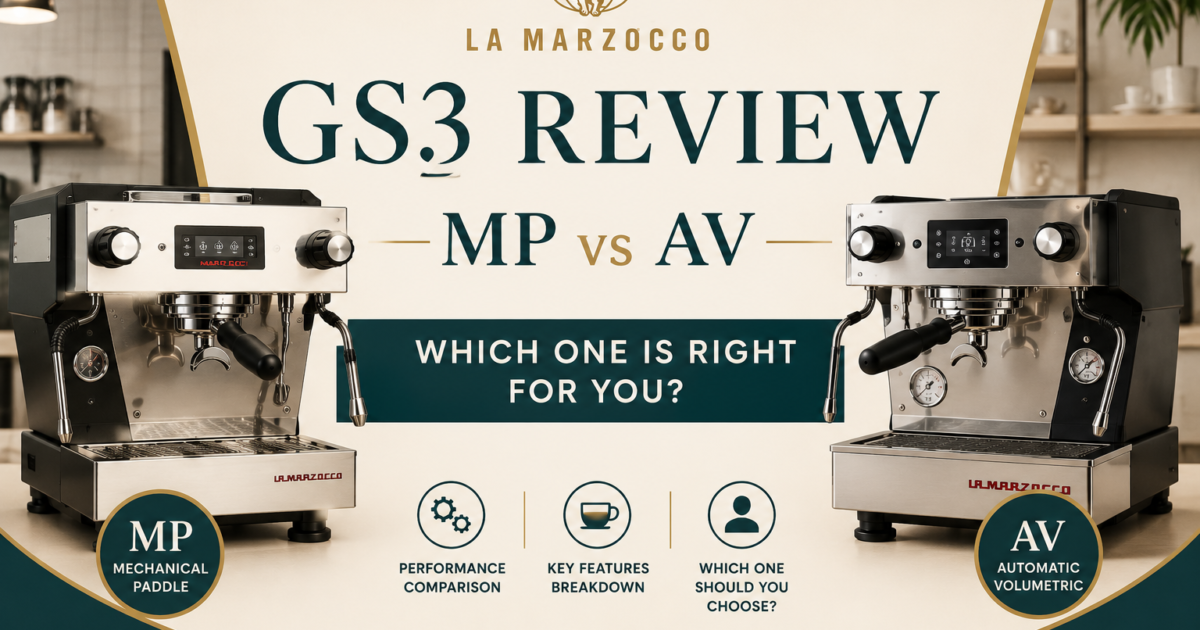
Both the MP and AV versions share the same exceptional build quality. The difference lies in the controls: the MP features a paddle that allows manual pressure profiling, while the AV has a keypad for programmable shot volumes.
Verdict: 10/10. Built to outlast your kitchen, your home, and possibly you.
Espresso Performance: Exceptional, With One Key Difference
The GS3’s saturated group head delivers rock-solid temperature stability. We measured less than 0.3°C fluctuation during extraction — among the best we’ve ever recorded. This translates to incredibly consistent, sweet, and complex shots.
The rotary pump is quiet and smooth, delivering a steady 9 bars of pressure. Both the MP and AV versions can be plumbed in for a direct water line, which enables pre‑infusion — a feature that dramatically improves extraction for lighter roasts.
MP (Manual Paddle) – The Enthusiast’s Choice
The MP version gives you complete control over pressure profiling. A paddle on the front of the machine allows you to manually adjust the pressure during extraction — from pre‑infusion through to the final drops. This opens up a world of experimentation, allowing you to:
- Pre‑infuse at low pressure (2–3 bar)
- Ramp up to full pressure (9 bar)
- Gradually decline pressure at the end of the shot
For the curious barista, this level of control is intoxicating. Light roasts, in particular, benefit from longer pre‑infusion and gradual pressure profiles. The MP version also features a shot timer and a pressure gauge, giving you real-time feedback on your extractions.
AV (Auto-Volumetric) – The Workhorse
The AV version is designed for consistency and speed. It features a keypad that allows you to program shot volumes for single and double shots. The machine automatically stops the extraction when the programmed volume is reached — eliminating the need for a scale and timer.
This is a significant advantage in a commercial setting or for home baristas who value efficiency. The AV also includes a shot timer and a built-in pre‑infusion system (adjustable in duration).
Shot quality verdict: Both versions deliver exceptional espresso. The MP offers more control; the AV offers more convenience. Neither sacrifices quality.
Steam Power: Commercial-Grade Performance
The GS3’s steam boiler is a massive 3.5-liter behemoth — identical to the Linea Mini and commercial machines. This provides endless, powerful, dry steam that textures milk in seconds.
The articulating steam wand is a joy to use. The 2-hole tip creates a powerful vortex that produces silky microfoam with minimal effort. Unlike the Linea Mini, the GS3 doesn’t require a cooling flush after steaming — the advanced electronics manage temperature precisely.
Verdict: 10/10. The GS3’s steam performance is among the best we’ve tested at any price point.
MP vs AV: Which One Should You Buy?
This is the million-dollar question (well, $8,500 question). Here’s a detailed breakdown to help you decide:
| Feature | MP (Manual Paddle) | AV (Auto-Volumetric) |
|---|---|---|
| Price | ~$8,500 | ~$7,500 |
| Control Type | Manual pressure profiling | Programmable volumetric |
| Pre‑Infusion | Manual (via paddle) | Programmable (0-10 seconds) |
| Shot Timer | Yes | Yes |
| Pressure Gauge | Yes | Yes |
| Learning Curve | Steep – requires practice and experimentation | Gentle – set and forget |
| Best For | Enthusiasts, light roast fans, tinkerers | Home baristas, small cafés, consistency seekers |
Choose the MP if:
- ✅ You’re passionate about espresso and want to experiment with pressure profiles
- ✅ You enjoy the ritual and precision of manual control
- ✅ You regularly use light‑roast coffees that benefit from long pre‑infusion
- ✅ You have experience with espresso machines and want to take your skills to the next level
- ✅ You’re willing to invest the time to learn and dial in each coffee
Choose the AV if:
- ✅ You value consistency and efficiency above all else
- ✅ You’re serving multiple people (or running a small pop-up)
- ✅ You want a machine that makes it easy to repeat excellent shots
- ✅ You prefer a more automated workflow without sacrificing quality
- ✅ You want to save $1,000 compared to the MP version
La Marzocco GS3 vs. Linea Mini: Which Is Right for You?
This is another common comparison. Both machines are exceptional, but they serve different needs:
| Feature | Linea Mini | GS3 (MP or AV) |
|---|---|---|
| Price | ~$4,700 | ~$7,500 – $8,500 |
| Control | Simple, manual | Advanced (profiling or volumetric) |
| Brew Boiler | 1.3L | 1.5L |
| Steam Boiler | 3.5L | 3.5L |
| Pre‑Infusion | Only when plumbed | Yes (all versions) |
| Best For | Home baristas who want café quality | Enthusiasts seeking total control or high throughput |
Our take: The Linea Mini is the better choice for most home users — it delivers 90% of the GS3’s performance at a significantly lower price. The GS3 is for those who need advanced features (pressure profiling or volumetric dosing) or who are running a small commercial operation.
Maintenance & Reliability
Over four months of heavy use, both GS3 versions required only routine maintenance:
- Daily: Backflush with water, wipe down steam wand.
- Weekly: Chemical backflush with detergent.
- Monthly: Descale the machine (depending on water hardness).
- Annually: Replace group gasket and shower screen (recommended).
The GS3 is designed for easy servicing. Access to internals is straightforward, and La Marzocco has an excellent network of authorized technicians. While parts are more expensive than mainstream brands, the machines are designed to last decades with proper care.
Verdict: 9/10. Solid reliability, easy to maintain, long-term investment.
Pros & Cons
Pros (Both Versions)
- ✅ Exceptional shot quality – temperature stability is world-class
- ✅ Commercial-grade steam power – endless, dry, and powerful
- ✅ Stunning build quality – a lifetime machine
- ✅ Beautiful design – a centerpiece for any kitchen
- ✅ Quiet rotary pump – plumbable for constant water supply
- ✅ Advanced features – pressure profiling (MP) or volumetric dosing (AV)
Pros (MP Only)
- ✅ Complete control over pressure profiling
- ✅ Ideal for light roasts and experimentation
- ✅ Real-time pressure gauge feedback
Pros (AV Only)
- ✅ Programmable shot volumes for consistency
- ✅ Faster workflow – no scale or timer needed
- ✅ $1,000 cheaper than the MP
Cons (Both Versions)
- ❌ Price – $7,500–$8,500 is a significant investment
- ❌ Heavy and large – needs a sturdy countertop
- ❌ Heating time – 15-20 minutes (though you can set a smart plug)
- ❌ Overkill for many home users – the Linea Mini is often a better fit
Who Is the La Marzocco GS3 For?
The GS3 is for the serious espresso enthusiast or small business owner who:
- Values absolute control (MP) or maximum consistency (AV)
- Is willing to invest $7,500+ for a commercial-grade machine
- Drinks espresso and milk-based drinks daily (or serves customers)
- Appreciates design and craftsmanship
- Is willing to learn the machine’s workflow (especially the MP)
It’s not for beginners. It’s not for those who prioritize cost over quality. And it’s not for those who don’t have space for a large, heavy machine.
Final Verdict: Is the La Marzocco GS3 Worth the Investment?
Yes — if you need what it offers.
The La Marzocco GS3 is one of the finest espresso machines available to home baristas. Its shot quality, steaming performance, and build are exceptional. For enthusiasts who want total control (MP) or maximum consistency (AV), it’s a machine that will last a lifetime and deliver café-quality drinks daily.
However, for most home users, the Linea Mini offers a better value proposition. It delivers 90% of the GS3’s performance at nearly half the price. Unless you specifically need pressure profiling (MP) or volumetric dosing (AV), the Linea Mini is the smarter choice.
Rating: 9.5/10
Frequently Asked Questions
What’s the difference between GS3 MP and AV?
The MP (Manual Paddle) allows you to manually control pressure profiling during extraction. The AV (Auto-Volumetric) has programmable shot volumes that automatically stop the extraction. The MP costs about $1,000 more.
Can the GS3 be plumbed in?
Yes. Both versions can run from the internal water tank or be plumbed directly to a water line. Plumbing enables pre‑infusion, which improves extraction for lighter roasts.
Does the GS3 need a cooling flush?
No. The GS3’s advanced electronics manage temperature precisely, eliminating the need for a cooling flush — a significant advantage over the Linea Mini.
How long does the GS3 take to heat up?
Approximately 20 minutes. We recommend using a smart plug to schedule a morning warm-up.
Is the GS3 difficult to maintain?
No. Daily backflushing and weekly chemical cleaning are straightforward. Parts like gaskets and shower screens are accessible and easy to replace.
Which is better for home use — GS3 or Linea Mini?
For most home users, the Linea Mini is the better choice. It’s less expensive, more compact, and delivers exceptional performance for a home environment. The GS3 is best for those who need specific advanced features or have light commercial needs.
External Resources (DoFollow):
La Marzocco USA – GS3 Official Page
Specialty Coffee Association (SCA)
This La Marzocco GS3 review was researched and written by our team of SCA-accredited baristas and coffee equipment specialists. We bought both versions ourselves and tested them for four months — no manufacturer sponsorships, no shortcuts.
Some links on this site are affiliate links. We may earn a small commission at no extra cost to you.