Gaggia Classic Pro vs Breville Barista Express: Which Beginner Machine Should You Buy?
Introduction
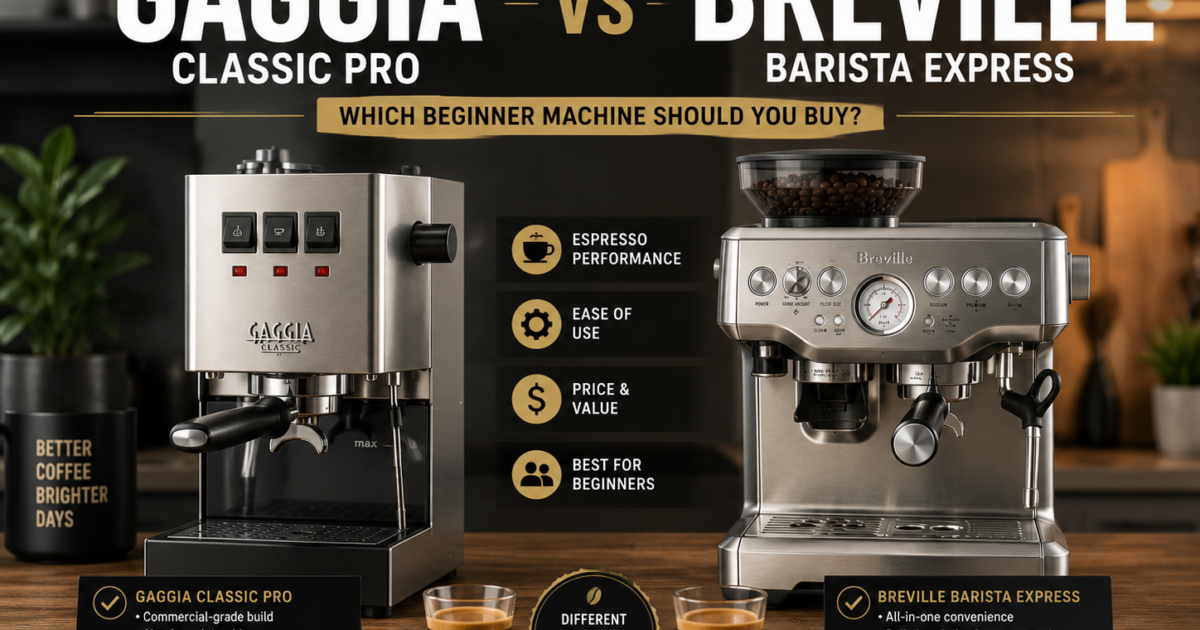
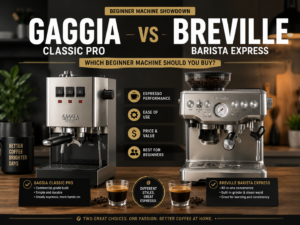
Every beginner home barista eventually lands on the same two names. The Gaggia Classic Pro and the Breville Barista Express have dominated the entry-level espresso conversation for years, and for good reason. Both deliver genuine espresso—not pressurized portafilter pretend-coffee—at a price that doesn’t require a second mortgage. But they represent fundamentally different philosophies about what a beginner machine should be.
This gaggia classic pro vs breville barista express comparison is based on hands-on testing of both machines over hundreds of shots. I’m not here to declare a universal winner. I’m here to tell you which one fits your kitchen, your patience level, and your long-term coffee ambitions. The wrong choice wastes money. The right choice lasts a decade.
For the full deep-dive on each machine after you’ve read this comparison, we have complete standalone reviews: Gaggia Classic Pro review and Breville Barista Express review.
Quick Comparison Table
| Feature | Gaggia Classic Pro | Breville Barista Express |
|---|---|---|
| Price (2026) | ~$450 | ~$750 |
| Boiler Type | Single aluminum boiler Better thermal stability | Single thermocoil Weaker steam |
| Portafilter | 58mm commercial Industry standard | 54mm proprietary |
| Heat-Up Time | 10-15 min (boiler) Slower | ~30 seconds (thermocoil) Near-instant |
| Built-in Grinder | None Separate purchase | Yes, conical burr All-in-one |
| Moddability | Extensive (PID, OPV, dimmer) Huge community | Limited (internal only) Locked down |
| Weight | 9.1 kg (20 lbs) | 9.5 kg (21 lbs) |
Build Quality
The Gaggia Classic Pro is built like a small Italian tank. The body is brushed stainless steel, the portafilter is heavy commercial-grade chromed brass, and the group head is the same 58mm standard used in cafés. There’s no plastic chassis hiding underneath. Open it up, and you’ll find a simple, repairable layout of switches, a boiler, and a pump. It’s designed to be fixed, not replaced. That 58mm portafilter means every tamper, distributor, and basket upgrade on the market fits natively.
The Breville Barista Express takes a different approach. The body is a mix of brushed stainless steel panels over a plastic internal frame. It doesn’t feel cheap—the fit and finish are excellent—but it doesn’t feel like commercial equipment either. The 54mm portafilter is proprietary, locking you into Breville’s ecosystem for baskets and tampers. The built-in grinder housing adds bulk, but the dosing system (grind directly into the portafilter with a push-button) is genuinely convenient. It’s an appliance designed for daily usability, not generational longevity.
Winner: Gaggia Classic Pro, on materials and serviceability. The Breville is well-made for its category, but the Gaggia is built to a different standard entirely.
Espresso Quality
Here’s the truth that spec sheets don’t capture: out of the box, the Breville makes better espresso for a beginner. The thermocoil heats in 30 seconds, the volumetric shot buttons stop at a programmed yield, and the built-in grinder is calibrated for espresso range. You can pull a drinkable shot within 10 minutes of unboxing.
The Gaggia Classic Pro, by contrast, demands more from you. The aluminum boiler needs a proper warm-up (10-15 minutes for thermal stability, not just ready-to-brew). The stock OPV spring is set to 12-14 bar, which is too high for modern espresso. You’ll want to swap the OPV spring to 9 bar—a $10 mod that takes 10 minutes but transforms shot quality. Once that’s done, and paired with a proper grinder, the Gaggia pulls shots that rival machines at triple the price. The boiler provides better temperature stability than a thermocoil, and the 58mm group gives you puck geometry that extracts more evenly.
The ceiling on the Gaggia is dramatically higher. The floor is lower. The Breville gives you a higher floor but a lower ceiling. If you never upgrade the grinder or learn temperature surfing, the Breville will consistently outperform the Gaggia. If you’re willing to tweak, the Gaggia leaves the Breville behind.
Winner: Gaggia Classic Pro (post-OPV mod, with a good grinder). For out-of-box experience, Breville takes it.
Ease of Use & Learning Curve
The Breville Barista Express is built for speed and forgiveness. The thermocoil hits brew temperature in under a minute. The built-in grinder doses directly into the portafilter with a press. The volumetric buttons stop the shot automatically. The pressure gauge gives visual feedback on whether your grind size is in the right ballpark. For someone who wants espresso without a hobby, this is the friendliest entry point available.
The Gaggia Classic Pro is manual. You grind separately. You dose, distribute, and tamp without assistance. You flip the brew switch, start a timer, and stop the shot manually based on weight or time. The steam wand is powerful but not instant—you wait for the boiler to transition from brew to steam temperature. Temperature surfing (a rhythmic dance of flushing and timing) becomes second nature, but it’s a learned skill. The upside: you learn what espresso actually is. The downside: it takes longer to get consistent.
Winner: Breville Barista Express, by a wide margin. It’s the machine for people who want coffee, not a project.
Maintenance
The Gaggia Classic Pro is famously repairable. Every component—pump, boiler, switches, thermostat—is a standard part available for under $50. The community has YouTube guides for every conceivable repair. Descaling is straightforward via the pump. The steam wand needs purging and wiping after each use. If something breaks in 5 years, you fix it for the cost of a pizza.
The Breville Barista Express is less DIY-friendly. Internal repairs often require shipping the unit to Breville’s service center. The built-in grinder adds a failure point. Descaling and cleaning cycles are semi-automated with indicator lights, which is helpful, but the proprietary parts mean you’re dependent on Breville’s support ecosystem. The solenoid valve and thermocoil are not user-serviceable.
Winner: Gaggia Classic Pro. It’s a machine designed to be maintained, not discarded.
Who Should Buy the Gaggia Classic Pro
☕ The Gaggia Classic Pro Is For You If:
- You want to learn espresso as a craft, not just consume it.
- You already own a quality grinder, or plan to buy one separately.
- You enjoy tinkering—mods, upgrades, and dialing in manually.
- You want a machine that can last 10+ years with basic repairs.
- You care about 58mm compatibility for accessories.
Read our full Gaggia Classic Pro review for detailed shot data, modding guides, and long-term reliability notes.
Who Should Buy the Breville Barista Express
⚡ The Breville Barista Express Is For You If:
- You want espresso in under a minute from power-on.
- You don’t want to buy a separate grinder.
- You value convenience features (auto-dosing, volumetric shots, pressure gauge).
- You want a gentle learning curve with forgiving results.
- You’re not interested in modifying or repairing your machine.
Read our full Breville Barista Express review for grind consistency tests, workflow deep-dives, and longevity reports.
Final Verdict
This gaggia classic pro vs breville barista express comparison doesn’t end in a knockout. It ends in a fork in the road. These machines are built for two entirely different people, and choosing correctly depends entirely on self-awareness.
If you see espresso as a journey—something you want to master, modify, and obsess over—the Gaggia Classic Pro is the only choice under $500 that doesn’t limit your ceiling. Buy it, install the 9-bar OPV spring, pair it with a proper grinder, and you have a machine that can compete with café shots for years.
If you see espresso as a morning ritual that shouldn’t feel like work—something you want to enjoy without a learning curve measured in months—the Breville Barista Express delivers. The built-in grinder, fast heat-up, and automated features mean you spend more time drinking and less time troubleshooting. It’s the smarter purchase for the coffee lover who isn’t a hobbyist.
Gaggia Classic Pro
For the aspiring home barista. Higher ceiling, more demanding. Needs a separate grinder.
Breville Barista Express
For the convenience-first coffee lover. All-in-one, fast, forgiving. Less upgrade potential.
Still undecided? Browse our complete best espresso machines guide to see how these compare against the wider field, or start with the beginner’s school if you’re brand new to espresso.
Frequently Asked Questions
Q: Can the Breville Barista Express grind fine enough for espresso?
A: Yes. The built-in conical burr grinder has sufficient range for espresso, including light roasts. However, the step adjustments are relatively large, making precise dialing more difficult than with a stepless standalone grinder.
Q: Do I need a separate grinder for the Gaggia Classic Pro?
A: Absolutely. The Gaggia has no built-in grinder. You need a quality burr grinder capable of espresso-fine adjustments. Budget at least $200-300 for something like a Baratza Encore ESP or Eureka Mignon. Using pre-ground coffee in the pressurized basket is possible but severely limits quality.
Q: Which machine makes better latte art?
A: The Gaggia Classic Pro. Its boiler produces drier, more powerful steam than the Breville’s thermocoil, making microfoam texturing easier once you learn the technique. The Breville’s steam wand is fully capable but slower and wetter.
Q: Is the Gaggia Classic Pro hard to learn on?
A: Harder than the Breville, yes. Temperature surfing, manual shot timing, and dialing in without a built-in grinder require patience. Expect 2-4 weeks of inconsistency before you’re pulling reliably good shots. The learning curve is real, but the skills transfer to any future machine.
Q: Can you use the Breville Barista Express without the built-in grinder?
A: Yes. You can dose ground coffee directly into the portafilter, bypassing the built-in grinder. Many owners eventually upgrade to a standalone grinder and use the BBE as a brew-only machine. The 54mm portafilter remains the limitation, but it works perfectly well.
External Resources: For standardized espresso machine testing protocols, refer to the Speciality Coffee Association home brewer certification standards. Community-driven modding resources for the Gaggia Classic Pro can be found at r/gaggiaclassic.
Some links on this site are affiliate links. We may earn a small commission at no extra cost to you.