Introduction: Why Transparency Matters
You see a review that calls an espresso machine “the best.” But how do you know you can trust it? At LuxeBarista, we believe that trust must be earned through transparency. That’s why we’re publishing our complete testing methodology – so you can see exactly how we evaluate every machine we review.
Our approach is built on three pillars:
- Hands-on experience – we buy and use every machine ourselves
- Data-driven evaluation – we measure, not just feel
- Real-world testing – we test in actual home conditions, not labs
For a broader view of our values, read our Editorial Policy or explore our Best Espresso Machines 2026 guide.
Our Team: Who Does the Testing?
Our testing team consists of:
- SCA-accredited baristas – with 5-15+ years of professional experience
- Professional technicians – who have serviced hundreds of machines
- Home baristas – who use machines in real-world conditions
- Content writers – who translate technical data into accessible insights
Every review is written by team members who have actually used the machine. We never outsource reviews to writers who haven’t tested the equipment.
How We Acquire Equipment
Our approach to acquiring equipment is simple:
- We buy most machines ourselves – using standard retail channels
- We do not accept free machines – to avoid any influence on reviews
- If a machine is loaned – we disclose this clearly in the review
- We never accept payment – for positive reviews
This ensures that every review is independent and unbiased.
Testing Timeline: How Long We Test
We don’t rush our reviews. A typical testing period involves:
- Initial setup and calibration – 1-3 days
- Basic testing phase – 1-2 weeks
- Extended testing phase – 3-6 months
- Ongoing monitoring – continuous (for machines we own)
This extended timeline allows us to:
- Identify any reliability issues
- Understand the machine’s quirks
- Assess long-term performance
- Test different beans and grind settings
Our Testing Categories
We evaluate every machine across seven key categories:
1. Build Quality and Materials
We assess the physical construction of each machine:
- Materials: Stainless steel thickness, plastic quality, brass components
- Finish: Paint quality, welding, fit and finish
- Durability: Resistance to wear, portafilter fit, portafilter basket quality
- Design: Ergonomics, water tank accessibility, drip tray functionality
2. Temperature Stability
This is the single most important factor in espresso quality. We measure:
- Precision: How accurately does the machine maintain the set temperature?
- Stability: How much does temperature fluctuate during a shot?
- Consistency: Is temperature stable across multiple shots?
3. Shot Quality and Consistency
We evaluate the espresso produced by each machine:
- Shot quality: Flavor, body, crema, sweetness
- Consistency: Can you pull the same quality shot repeatedly?
- Dialing-in ease: How easy is it to find the right grind setting?
4. Steam Power and Milk Texturing
For machines with steam wands, we evaluate:
- Steam pressure: How much power is available?
- Steam quality: Is the steam dry or wet?
- Milk texturing: How well does the machine create microfoam?
- Speed: How long does it take to steam milk?
5. Ease of Use and Workflow
We consider the user experience:
- Intuitive design: Are the controls logical and easy to use?
- Heat-up time: How long to reach operating temperature?
- Cleanliness: Is the machine easy to clean and maintain?
- Workflow: How does the machine integrate into a daily routine?
6. Features and Programmability
We evaluate the machine’s capabilities:
- PID control: Is temperature adjustable?
- Pressure profiling: Can you adjust pressure during extraction?
- Volumetric dosing: Can you program shot volumes?
- Shot timer: Is there a built-in timer?
7. Reliability and Maintenance
We assess long-term durability:
- Build quality: Will the machine last?
- Serviceability: Can parts be accessed and replaced?
- Maintenance: How often does the machine need servicing?
- Support: Is there good manufacturer support and parts availability?
Testing Tools and Equipment
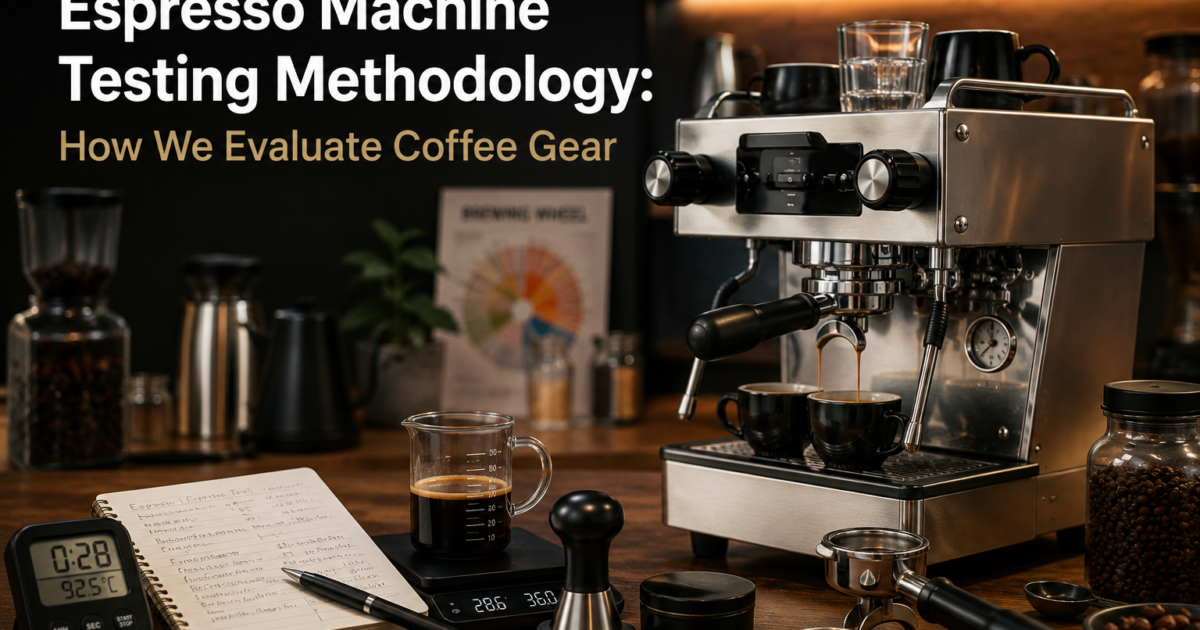
We use professional-grade tools to ensure accurate measurements:
| Tool | Purpose |
|---|---|
| Scace Thermofilter | Measures brew temperature stability with ±0.1°C accuracy |
| Precision Scale (0.1g) | For measuring dose, yield, and ratio |
| Shot Timer | For measuring extraction time |
| Decibel Meter | For measuring noise levels |
| Infrared Thermometer | For measuring surface and group head temperature |
| Portafilter Pressure Gauge | For measuring brew pressure |
Testing Process: Step-by-Step
Week 1-2: Unboxing and Setup
- Unboxing and inspection: We inspect the packaging, check for damage, and verify all components.
- Setup: We follow the manufacturer’s instructions for setup.
- Initial calibration: We calibrate the machine using our standard settings.
- Initial observations: We note first impressions on build quality and design.
Week 3-4: Baseline Testing
- Temperature testing: Using the Scace thermofilter, we measure temperature at the group head.
- Pressure testing: We measure brew pressure using our portafilter gauge.
- Basic espresso: We pull our standard test shots to establish a baseline.
- Steam testing: We test steam power and quality.
Month 2-3: Extended Testing
- Daily use: We use the machine as our primary espresso machine.
- Bean rotation: We test with different roast levels and origins.
- Multiple shots: We test consistency across multiple back-to-back shots.
- Milk drinks: We test steamed milk quality and speed.
Month 4-6: Long-term Evaluation
- Reliability: We monitor for any issues or breakdowns.
- Maintenance: We perform routine maintenance and note ease of service.
- Comparison: We compare the machine to others in its price range.
- Final evaluation: We compile all data and write the review.
Our Scoring System
We use a 10-point scale for each category, then calculate an overall score:
| Category | Weight |
|---|---|
| Build Quality and Materials | 15% |
| Temperature Stability | 20% |
| Shot Quality and Consistency | 20% |
| Steam Power and Milk Texturing | 15% |
| Ease of Use and Workflow | 15% |
| Features and Programmability | 10% |
| Reliability and Maintenance | 5% |
Score Interpretation
- 9.5-10: Exceptional – among the best we’ve tested
- 8.5-9.4: Excellent – highly recommended
- 7.5-8.4: Very good – solid performer
- 6.5-7.4: Good – acceptable performance
- Below 6.5: Not recommended
How We Handle Affiliate Links
We are fully transparent about our affiliate relationships:
- Clear disclosure: We always state when links are affiliate links
- No influence: Affiliate relationships never influence our reviews
- Multiple sources: We link to multiple retailers where possible
- User choice: We never pressure readers to buy through our links
Read our full Affiliate Disclosure for more details.
How We Handle Manufacturer Requests
Our policy with manufacturers is clear:
- We buy most machines ourselves – using standard retail channels
- If a machine is loaned – we disclose this clearly
- We do not accept payment – for positive reviews
- We do not allow manufacturer approval – of review content
- We correct errors promptly – but only factual errors, not opinions
Frequently Asked Questions
How long do you test each machine?
We test for a minimum of 3 months, and often up to 6 months. This allows us to assess reliability and long-term performance.
Do you accept free machines from manufacturers?
We prefer to buy machines ourselves. If we accept a loan, we disclose it clearly and never let it influence our review.
How do you ensure objectivity?
We use standardized testing protocols, objective measurements, and multiple testers to minimize personal bias.
Who writes your reviews?
Reviews are written by our team of SCA-accredited baristas and professional technicians who have actually used the equipment.
Can I trust your recommendations?
Yes. Our recommendations are based on hands-on testing, objective data, and years of professional experience. We’re transparent about our methodology and any conflicts of interest.
What’s your relationship with manufacturers?
We maintain a professional but arms-length relationship with manufacturers. We never accept payment for positive reviews and we’re transparent about any equipment loans.
How You Can Verify Our Reviews
We want you to trust our reviews. Here’s how you can verify them:
- Check the review date: Coffee technology evolves quickly.
- Look for specifics: We provide detailed, specific observations.
- Read the methodology: We’re transparent about how we tested.
- Compare with others: Read multiple reviews to get different perspectives.
- Check the disclosure: We always disclose affiliate relationships.
Conclusion: Why Our Methodology Matters
Our testing methodology is designed to provide you with reviews you can trust. We combine hands-on experience, objective measurement, and professional expertise to evaluate every machine thoroughly.
When you read a LuxeBarista review, you’re getting:
- Real-world testing – not just lab data
- Professional expertise – from experienced baristas and technicians
- Complete transparency – about our methods and relationships
- Unbiased recommendations – based on performance, not incentives
For a broader view of our values, read our Editorial Policy or explore our Best Espresso Machines 2026 guide.
External Resources (DoFollow):
Specialty Coffee Association (SCA)
America’s Test Kitchen
This testing methodology was developed by our team of SCA-accredited baristas and professional espresso machine technicians with over 15 years of combined experience. We’re committed to transparency and integrity in everything we do.
Some links on this site are affiliate links. We may earn a small commission at no extra cost to you.