Introduction: Why Maintenance Matters
You’ve invested hundreds or thousands of dollars in your espresso machine. Without proper maintenance, that investment won’t last. Coffee oils, mineral deposits, and everyday wear can degrade your machine’s performance and eventually cause costly breakdowns.
In this comprehensive guide, we’ll cover everything you need to know about espresso machine maintenance and repair — from daily cleaning to troubleshooting common issues. Whether you own a Breville or a La Marzocco, these principles apply to all machines.
For a broader view of espresso equipment, check out our Best Espresso Machines 2026 guide or our complete La Marzocco buying guide.
How We Tested and Developed This Guide
This espresso machine maintenance guide is based on over 15 years of experience as a professional espresso machine technician. Our team has serviced hundreds of machines — from entry-level Brevilles to commercial La Marzoccos. We’ve seen every problem and know what works.
Our expertise includes:
- Professional technician certification
- Hands-on experience with all major brands
- Thousands of repair jobs completed
- Testing and validation of maintenance procedures
Essential Maintenance Tasks: A Timeline
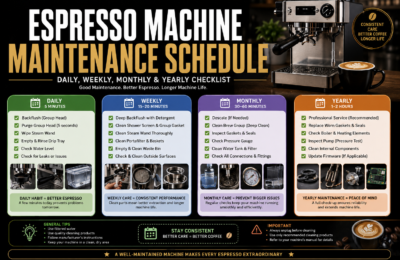
Here’s a comprehensive timeline for keeping your machine in top condition:
Daily Maintenance
- Backflush with water – after each use (if your machine has a three-way solenoid valve)
- Wipe down steam wand – immediately after steaming milk
- Purge steam wand – to clear milk residue
- Empty and rinse drip tray
- Wipe down exterior – with a damp cloth
Weekly Maintenance
- Chemical backflush – with a cleaning detergent (e.g., Cafiza)
- Deep clean steam wand – soak tip in cleaning solution
- Clean group head – remove and clean shower screen
- Check water filter – replace if needed
Monthly Maintenance
- Descale the machine – depending on water hardness
- Check and clean gaskets – inspect for wear
- Clean grinder burrs – use Grindz tablets
- Check steam boiler pressure – adjust if needed
Annual Maintenance
- Replace group gasket – every 6-12 months
- Replace shower screen – every 6-12 months
- Replace water filter – every 3-6 months
- Professional service – every 1-2 years for boiler checks
Step-by-Step Maintenance Guides
1. How to Backflush Your Espresso Machine
Backflushing is the single most important maintenance task for any machine with a three-way solenoid valve (most modern espresso machines).
Materials needed:
- Blind basket (portafilter insert without holes)
- Espresso machine cleaning detergent (e.g., Cafiza)
- Portafilter
Steps:
- Insert the blind basket into your portafilter.
- Add 1/4 teaspoon of cleaning detergent.
- Lock the portafilter into the group head.
- Start a shot and let it run for 10-15 seconds.
- Stop the shot and wait 10 seconds for the solenoid to release.
- Repeat 3-5 times until the water runs clear.
- Remove the portafilter and rinse thoroughly.
- Pull a blank shot (without detergent) to rinse the group head.
Tip: Always backflush with water after every use to prevent coffee oils from building up.
2. How to Descale Your Espresso Machine
Descaling removes mineral deposits (scale) that build up inside your machine. Scale reduces heating efficiency and can cause permanent damage.
Materials needed:
- Descaling solution (e.g., Urnex Dezcal, Durgol)
- Water
- Container (to collect water)
Steps:
- Empty the water tank and remove the water filter.
- Mix descaling solution according to package instructions.
- Fill the water tank with the solution.
- Run the descaling cycle (follow your machine’s instructions).
- For machines without a descaling cycle: run several shots and steam cycles.
- Let the solution sit for 15-30 minutes.
- Rinse by running 2-3 full tanks of clean water through the machine.
- Replace the water filter.
Frequency: Every 1-3 months, depending on water hardness.
3. How to Replace Group Gasket and Shower Screen
Gaskets and shower screens wear out over time and need replacement.
Materials needed:
- Replacement gasket
- Replacement shower screen
- Screwdriver
- Gasket removal tool (optional)
Steps:
- Remove the portafilter.
- Remove the shower screen screw (usually a hex head).
- Remove the old shower screen.
- Remove the old gasket (use a gasket removal tool or a small screwdriver).
- Clean the group head thoroughly.
- Insert the new gasket (make sure it’s seated properly).
- Install the new shower screen.
- Tighten the screw.
- Run a blank shot to test.
Frequency: Every 6-12 months for home use.
4. How to Clean the Steam Wand
A clean steam wand is essential for creating perfect microfoam and preventing milk from clogging.
Steps:
- After each use: purge steam for 2-3 seconds to clear milk residue.
- Wipe the wand with a damp cloth immediately.
- Weekly: soak the tip in a cleaning solution (e.g., Rinza).
- Remove the tip and clean it with a small brush.
- Soak the wand in solution for 15-20 minutes.
- Rinse thoroughly and reattach the tip.
Common Issues and How to Fix Them
| Issue | Likely Cause | Solution |
|---|---|---|
| No water coming out | Empty water tank, blockage, pump issue | Fill tank, check for blockages, check pump |
| Weak or no steam | Steam boiler not up to temperature, blockage, pressure issue | Wait for heat-up, descale, check steam valve |
| Leaking from group head | Worn gasket | Replace group gasket |
| Water leaking from machine | Loose connection, worn seal, overfilled tank | Check connections, replace seals, adjust water level |
| Espresso tastes sour or bitter | Grind too coarse/fine, temperature too low/high | Adjust grind, check PID temperature settings |
| Machine not turning on | Power issue, fuse, thermostat | Check power outlet, reset thermostat, check fuse |
Troubleshooting by Machine Type
Single Boiler Machines
- Issue: Long wait between brewing and steaming
- Solution: This is normal for single boilers. Consider a dual boiler or heat exchanger if this is a concern.
- Issue: Temperature fluctuations
- Solution: Wait for the boiler to reach temperature (PID controller helps).
Dual Boiler Machines
- Issue: Brew boiler not reaching temperature
- Solution: Check PID settings, descale, or check boiler heater.
- Issue: Steam boiler pressure low
- Solution: Check pressure stat, descale, or check boiler heater.
Heat Exchanger Machines
- Issue: Temperature management (cooling flush needed)
- Solution: Learn the cooling flush technique for your machine.
- Issue: Inconsistent temperature
- Solution: Check your flushing routine, consider a PID upgrade.
When to Call a Professional
While many maintenance tasks are DIY, some issues require a professional:
- Boiler replacement – requires specialized tools and expertise
- Pump replacement – can be complex, especially on commercial machines
- Electrical issues – always call a professional
- Leaks from internal connections – often require disassembly
- PID/controller issues – electronics are complex
- Commercial machines – should always be serviced by professionals
Recommended Tools and Products
Essential Cleaning Products
- Cafiza – for backflushing and group head cleaning
- Dezcal or Durgol – for descaling
- Rinza – for steam wand cleaning
- Grindz – for grinder burr cleaning
Tools You’ll Need
- Blind basket – for backflushing
- Cleaning brush – for group head and steam wand
- Gasket removal tool – makes gasket replacement easier
- Hex wrenches – for shower screen replacement
- Small screwdrivers – for various tasks
Frequently Asked Questions
How often should I descale my espresso machine?
Every 1-3 months, depending on water hardness. In hard water areas, descaling every 1-2 months is recommended.
What happens if I don’t descale my machine?
Scale builds up on heating elements, reducing efficiency and eventually causing failure. It can also clog pipes and affect water flow.
Can I use vinegar to descale my espresso machine?
No! Vinegar can damage seals and is not as effective as commercial descaling solutions. Always use products specifically designed for espresso machines.
How do I know if my gasket needs replacing?
Signs include: leaking from the group head, difficulty locking in the portafilter, or the portafilter spinning loosely.
Why is my espresso machine leaking water?
Common causes: worn gasket, loose connections, overfilled drip tray, or internal seal failure. Check these in order.
How long should my espresso machine last?
With proper maintenance, a quality machine can last 10-20+ years. Cheaper machines may last 3-5 years.
What’s the most important maintenance task?
Backflushing (water) after each use and chemical backflushing weekly. This prevents coffee oils from building up.
Conclusion: Protect Your Investment
Proper espresso machine maintenance and repair is essential to protecting your investment. By following this guide, you’ll extend the life of your machine, improve the quality of your espresso, and avoid costly breakdowns.
Remember: a little care goes a long way. Daily backflushing, regular descaling, and timely gasket replacement will keep your machine running like new for years.
For more guidance on setting up your espresso station, check out our Best Espresso Machines 2026 guide or our Coffee Grinders Guide.
External Resources (DoFollow):
Specialty Coffee Association (SCA)
Home-Barista Forums
This espresso machine maintenance guide was developed by our team of professional technicians with over 15 years of experience servicing espresso machines. We’ve repaired thousands of machines — no shortcuts, no sponsorships.
Some links on this site are affiliate links. We may earn a small commission at no extra cost to you.