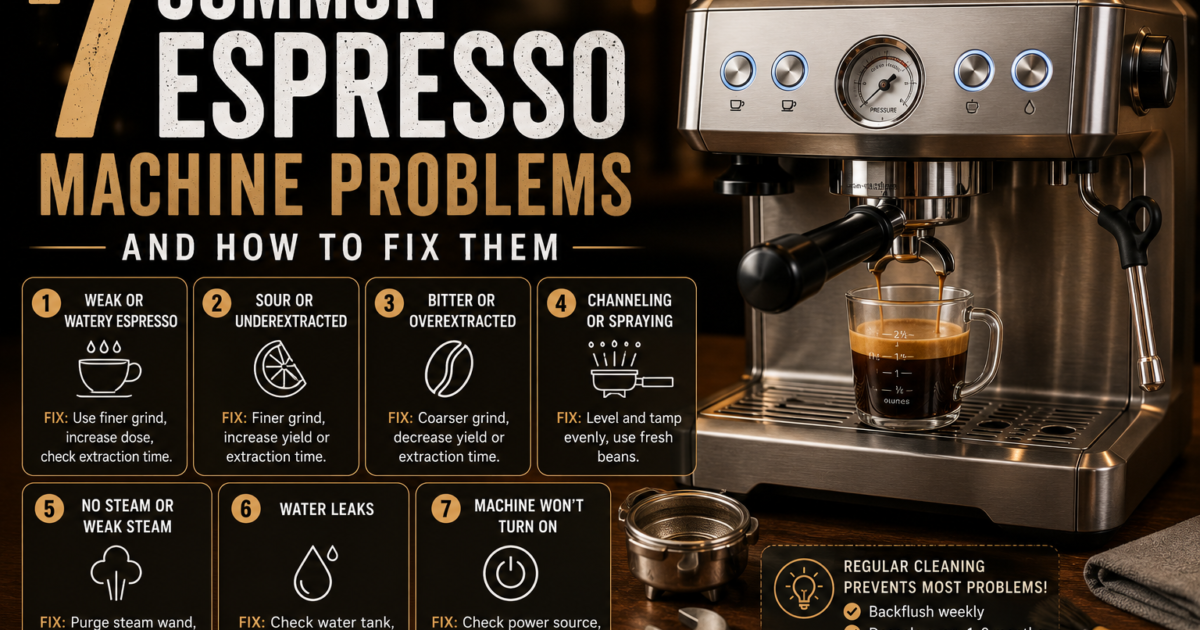
7 Common Espresso Machine Problems and How to Fix Them
No pressure, weak shots, leaking, or no steam — here are the most common espresso machine problems and the fixes that actually work.

Espresso machine problems tend to show up the same way for almost everyone: a shot that used to look right suddenly runs too fast, too slow, or doesn’t build pressure at all. Before you assume something’s actually broken, it’s worth knowing that most espresso machine problems come down to three root causes — grind size, dose, or scale buildup — not a mechanical failure.
Below are the seven espresso machine problems we hear about most often, with the fix for each.
Jump to a problem
Want a faster diagnosis than reading through all seven? Answer a couple of quick questions and get a direct fix.
Problem 1
No Pressure / Weak, Watery Shots
This is the most common espresso machine problem by a wide margin, and the cause is almost always upstream of the machine itself.
Likely causes
- Grind size too coarse — water is passing through too quickly to build resistance
- Dose too low for your basket size
- Scale buildup restricting water flow through the boiler or group head
The fix
Grind finer first — this solves the majority of “no pressure” complaints on its own. If that doesn’t help, check your dose against your basket’s rated capacity, and if your machine is overdue, run a full descaling cycle.
Problem 2
Shot Runs Too Fast
A shot that finishes in 10-15 seconds instead of the usual 25-30 is under-extracting, which produces a sour, thin, watery result.
Likely causes
- Grind size too coarse
- Dose too low
- Uneven tamping, creating a path of least resistance for water (channeling)
The fix
Grind finer and increase your dose slightly. Make sure your tamp is level and consistent — an uneven tamp is one of the most overlooked causes of a fast, channeled shot. Our dial-in guide covers this in more depth.
Problem 3
Leaking from the Group Head or Portafilter
A little dripping from the portafilter spouts after a shot is normal. Steady leaking during brewing is not.
Likely causes
- Worn or hardened group head gasket
- Coffee grounds built up on the group head seal
- Portafilter not locked in fully
The fix
Wipe the group head seal clean after every shot as part of your routine — this alone prevents a lot of leaks. If leaking continues, the gasket has likely hardened with age and needs replacing, which is a straightforward DIY fix on most machines with a widely available part.
Problem 4
Water Isn’t Heating
If your machine is running but water is coming out lukewarm or cold, this is one of the few problems on this list worth taking seriously right away.
Likely causes
- Heavy scale buildup insulating the heating element
- A failing heating element or thermostat
The fix
Start with a thorough descale — scale buildup is the far more common cause. If temperature doesn’t improve after descaling, this is one of the cases where it’s worth contacting the manufacturer or a technician rather than continuing to troubleshoot electrical components yourself.
Problem 5
No Steam or Weak Steam
Weak or absent steam is frustrating but almost always fixable without a repair.
Likely causes
- Scale buildup in the boiler or steam wand
- Clogged steam tip
- Not waiting long enough for the boiler to reach steam temperature (single boiler machines)
The fix
On single boiler machines, give the machine a full minute or two after switching to steam mode before expecting full steam power. Soak the steam tip in warm water to clear dried milk, and if it’s been a while, run a descaling cycle — see our full maintenance schedule for how often that should be.
Problem 6
Machine Won’t Turn On
Before assuming the worst, rule out the simple stuff.
Likely causes
- Outlet or power strip issue, not the machine
- Water reservoir not seated correctly (some machines won’t power the boiler without it detected)
- Tripped internal thermal safety switch from overheating
The fix
Test the outlet with another device, reseat the water tank fully, and let the machine cool for 30 minutes if it recently overheated or shut off unexpectedly. If none of that resolves it, this is an electrical issue worth handing to a professional rather than opening the machine yourself.
Problem 7
Coffee Grounds in the Cup
Fine sediment in your cup is annoying but rarely a sign of a serious problem.
Likely causes
- Grind too fine for your basket or grinder
- Worn grinder burrs producing inconsistent particle sizes
- A crack or damage in the portafilter basket
The fix
Coarsen your grind slightly and inspect your basket for damage. If your grinder is older, worn burrs can start producing “fines” that pass through the basket — see our grinder guide if you think it’s time to replace yours.
Still Not Fixed?
If you’ve worked through grind size, dose, and a full descale and the problem persists — or you notice burning smells, unusual noises, or electrical issues — stop troubleshooting and contact a qualified technician or the manufacturer directly. For everything else, our Espresso Troubleshooter tool can point you to a fix in under a minute.
Frequently Asked Questions
Why is my espresso machine not building pressure?
Low or no pressure is almost always caused by grind size that’s too coarse, an underfilled portafilter basket, or scale buildup restricting water flow. Start by checking your grind and dose before assuming it’s a mechanical fault.
Is it normal for an espresso machine to leak a little?
A small amount of dripping from the portafilter spouts after a shot is normal. Steady leaking from the group head, the base of the machine, or the portafilter during brewing is not normal and usually points to a worn gasket, loose fitting, or a grounds buildup on the group head seal.
Why does my espresso machine have no steam or weak steam?
Weak steam is most often caused by scale buildup restricting the boiler or steam wand, a clogged steam tip, or (on single boiler machines) not waiting long enough after switching from brew mode to steam mode for the boiler to fully reach steam temperature.
When should I stop troubleshooting and call a technician?
If you’ve ruled out grind size, dose, and descaling and the problem persists, or if you notice unusual noises, burning smells, or electrical issues, stop troubleshooting yourself and contact a qualified technician or the manufacturer.
General maintenance and safety guidance informed by consumer appliance care standards from the U.S. Consumer Product Safety Commission and brewing standards from the Specialty Coffee Association.
Some links on this site are affiliate links. We may earn a small commission at no extra cost to you.