How to Backflush an Espresso Machine (Daily & Weekly Routine)
What Backflushing Does
Backflushing is not descaling. The two terms get confused constantly, but they target completely different problems. Descaling removes mineral buildup inside the boiler and water pathways. Backflushing cleans the group head—specifically the shower screen, dispersion block, and the narrow channel that leads to the three-way solenoid valve.
Every time you pull a shot, coffee oils and microscopic grounds are forced upward into the group head under 9 bars of pressure. Over days, these residues accumulate, oxidize, and turn rancid. Your next shot flows through this layer of stale coffee residue. The result: muted flavors, a persistent bitter aftertaste that isn’t from your beans, and eventually, a clogged solenoid valve that stops the machine from releasing pressure properly. That’s the “sneeze” when you remove the portafilter—a pressurized burst of hot water and grounds that sprays your counter.
Learning how to backflush an espresso machine is the single highest-impact maintenance habit you can build. It takes 30 seconds daily and 5 minutes weekly. The payoff is cleaner shots, longer machine life, and avoiding a $200 solenoid valve replacement. For the complete maintenance picture, our espresso machine maintenance hub covers everything from descaling to gasket swaps.
Which Machines Need It (And Which Don’t)
Backflushing only works on machines equipped with a three-way solenoid valve. This is the electrically controlled valve that releases pressure from the group head after a shot finishes. When you insert a blind basket and run the pump, pressure builds behind the basket, and the only escape path is backward through the solenoid valve into the drip tray. That backward flow is what scrubs the internal passages clean.
Machines WITH a three-way solenoid valve (backflush compatible):
- Gaggia Classic Pro — Yes, standard three-way valve. Backflush regularly.
- Rancilio Silvia — Yes.
- ECM, Profitec, Lelit, Rocket dual boilers — Yes.
- La Marzocco Linea Mini — Yes, commercial solenoid.
- La Marzocco GS3 — Yes.
- Breville Dual Boiler — Yes.
Machines WITHOUT a three-way solenoid valve (do NOT backflush):
- Breville Bambino (standard and Plus) — No solenoid. The portafilter will remain pressurized after the shot. Do not backflush.
- Delonghi Dedica and most entry-level Delonghi models — No solenoid.
- Most pressurized-only machines under $200 — No solenoid.
⚠️ How to Check If Your Machine Has a Three-Way Valve
Pull a shot normally. When the pump stops, look at the drip tray. If you hear a “whoosh” and see water discharge into the drip tray within 2-3 seconds, you have a three-way solenoid. If the portafilter stays wet and pressurized, and water only slowly drips out, you don’t. Alternatively, check your manual—it will explicitly state if backflushing is supported or not. If you’re unsure, do not attempt chemical backflushing. Forcing pressure through a machine without a release pathway can damage the pump.
Daily Water Backflush (30 Seconds After Your Last Shot)
The water-only backflush is your daily reset. It uses no chemicals—just clean water and a blind basket. Do this after every session, or at minimum once daily if you pull shots throughout the day. It removes fresh coffee oils before they oxidize and harden.
🕐 Daily Routine Summary
- Frequency: After every session, or once daily minimum
- Time: 30 seconds
- Tools: Blind basket only
- Detergent: None — water only
-
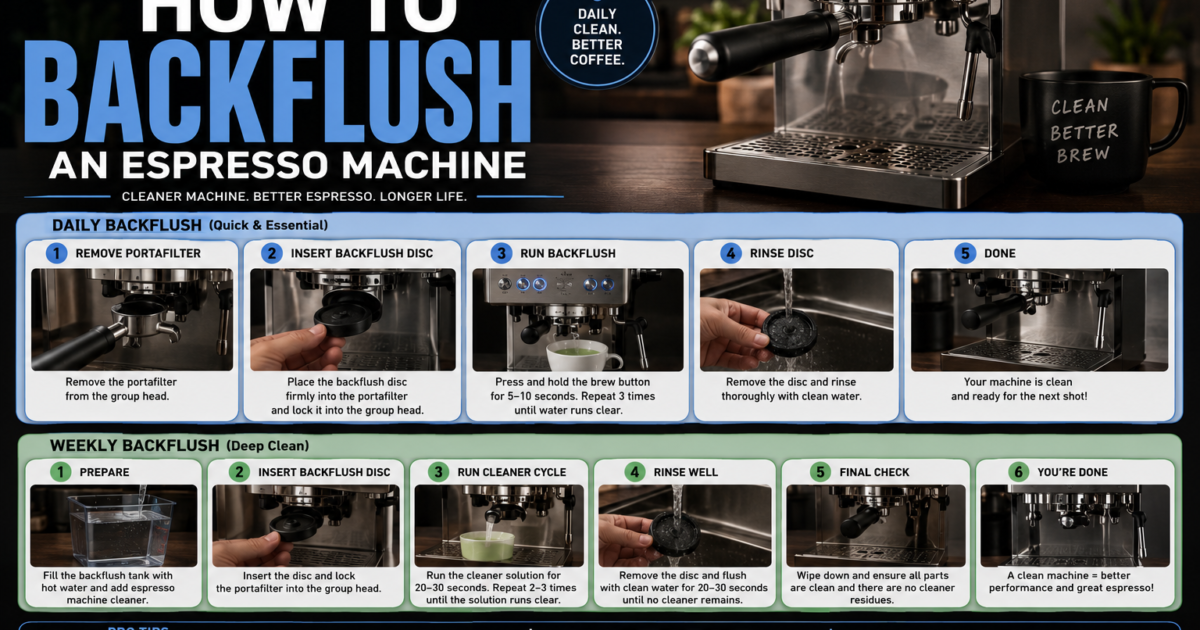
Remove the portafilter and knock out the puck
Discard the spent coffee puck immediately after your last shot. Rinse the portafilter basket briefly under hot water to remove loose grounds. You’ll be using the portafilter for the backflush, so it needs to be clean.
-
Insert the blind basket
Swap your regular filter basket for the blind basket (also called a backflush disc or blank basket). This is a solid metal basket with no holes, usually included with your machine. If you’ve lost it, replacements cost under $10. Lock the portafilter into the group head as you normally would.
-
Run the pump for 5 seconds
Activate the brew switch or lever. Pressure will build almost immediately—you’ll hear the pump labor and see the pressure gauge (if equipped) spike to maximum. Run for 5 seconds, then stop.
-
Wait for the solenoid to discharge
When you stop the pump, the three-way solenoid valve opens automatically. You’ll hear a distinct “whoosh” or “sneeze” sound, and water will rush into the drip tray. This backward surge of water is what flushes the group head internals. Wait 3-5 seconds for it to complete.
-
Repeat 3-5 times
Run the pump for 5 seconds, stop, let the solenoid discharge. Repeat this cycle 3 to 5 times. After the final cycle, remove the portafilter. The blind basket should contain some dark, oily water. Pour it out. That’s the residue that would have been in your next morning’s shot.
-
Rinse and wipe the group head
Remove the blind basket, rinse the portafilter, and reinsert your regular basket. Run a quick 3-second flush with no portafilter attached to rinse the shower screen. Wipe the group gasket area with a clean, dry cloth.
That’s it. Thirty seconds. No chemicals. No disassembly. This alone will dramatically extend the interval between chemical cleanings and keep your shots tasting fresh.
Weekly Chemical Backflush (5 Minutes, Once a Week)
The chemical backflush uses a specialized espresso machine cleaning detergent—not dish soap, not vinegar, not descaling solution. These detergents are formulated to dissolve polymerized coffee oils that water alone cannot remove. They’re alkaline, slightly caustic when concentrated, and absolutely essential for long-term group head health.
🧪 Weekly Routine Summary
- Frequency: Once per week (or every 50-75 shots)
- Time: 5 minutes
- Tools: Blind basket, espresso detergent powder
- Detergent: Cafiza, Puly Caff, or manufacturer-branded cleaner
✅ Recommended Detergents
Urnex Cafiza is the industry standard. Puly Caff is equally effective and common in Europe. Most machine brands (Breville, Gaggia, La Marzocco) sell rebranded versions of these same formulations. Use what’s available. One $15 bottle of Cafiza powder lasts over a year of weekly backflushing. Do not substitute dish soap, vinegar, baking soda, or descaling solution. These won’t dissolve polymerized coffee oils and some will damage internal seals.
-
Start with a water backflush first
Run 2 cycles of the daily water backflush described above. This clears loose oils and prevents the detergent from being immediately saturated with fresh residue. You want the chemical cleaner to attack the baked-on stuff, not yesterday’s easy-to-rinse oils.
-
Add detergent to the blind basket
Insert the blind basket into your portafilter. Add a small scoop of espresso cleaning powder—roughly 1/4 teaspoon, or the amount specified on your detergent’s packaging. A little goes a long way. Too much detergent creates excessive foam that’s hard to flush.
-
Lock and run the pump for 10 seconds
Lock the portafilter into the group head. Start the pump and let it run for 10 seconds. The detergent will dissolve and pressurize behind the blind basket. You’ll hear the pump load up and the pressure gauge max out.
-
Stop and let the detergent dwell for 30 seconds
Stop the pump. Do not remove the portafilter. The solenoid will discharge some water, but detergent-laden water remains in the group head passages. Let it sit for 30 seconds. This dwell time is when the alkaline detergent chemically breaks down polymerized coffee oils.
-
Pulse 5 times: 10 seconds on, 5 seconds off
Run the pump for 10 seconds, stop for 5 seconds while the solenoid discharges. Repeat this pulse cycle 5 times. Each pulse scrubs a fresh burst of detergent through the three-way valve pathway. After the 5th pulse, you’ve effectively scoured the entire group head circuit.
-
Remove, inspect, and rinse the portafilter
Remove the portafilter. The water in the blind basket will be dark brown and may have small black flecks—that’s the dissolved coffee residue. Rinse the portafilter and blind basket thoroughly under running water.
-
Flush with clean water — thoroughly
This step is critical. Detergent residue tastes awful and can make you sick. Reinsert the blind basket (now clean, with no detergent) and run 5-7 full water-only backflush cycles. After each cycle, check the water in the blind basket. If it’s still foamy or smells of detergent, keep flushing. Once the water runs clear and odorless, you’re done.
-
Final flush and seasoning shot
Remove the blind basket, reinsert your regular basket. Run water through the group head for 10 seconds with no portafilter. Wipe the group gasket. Pull a “seasoning shot” with a small dose of old coffee or the day’s first puck—discard this shot. It coats the clean metal surfaces and ensures your actual drink doesn’t taste sterile or metallic.
⚠️ Important: Detergent Is Not for the Water Tank
Espresso machine cleaning powder goes in the blind basket, never in the water reservoir. It’s designed to clean the group head and solenoid valve pathway under pressure, not to circulate through the boiler. Putting Cafiza in your water tank will fill your boiler with foaming detergent that’s nearly impossible to flush completely. You’ll taste it for weeks.
Signs You’re Overdue for a Backflush
Your machine will tell you when it needs attention. These symptoms indicate you’ve gone too long without backflushing, and a chemical cleaning cycle is overdue immediately:
- Bitter, harsh, or “off” aftertaste in every shot, regardless of bean freshness or grind adjustment. This is the most common sign. Rancid coffee oils coating the group head impart a sharp, stale bitterness that no amount of dialing in can fix.
- Water takes longer to flow from the group head during a blank flush. If the stream looks uneven or slow, the dispersion block and shower screen are partially clogged.
- Loud “sneeze” or portafilter blowback when you unlock the portafilter after a shot. This means the solenoid valve isn’t releasing pressure properly because it’s gummed up with residue. A violent sneeze sprays hot grounds across your kitchen. It’s also a burn risk.
- Drip tray fills with dark, oily water even when you haven’t pulled a shot recently. This is residue slowly leaching out of the solenoid pathway.
- Pressure gauge behaves erratically during extraction, spiking or dropping in ways that don’t match your grind changes. A partially blocked solenoid affects pressure release dynamics.
If you’re experiencing any of these, run a full chemical backflush cycle immediately, then establish the daily water backflush habit going forward. Prevention is 30 seconds. Cure is a teardown and deep clean.
Frequently Asked Questions
Q: How often should I backflush with detergent?
A: Once per week for home use (roughly 50-75 shots). If you pull fewer than 7 shots a week, every 2 weeks is acceptable. In a small café or high-volume home setting, daily chemical backflushing is standard. The daily water-only backflush should be done every day you use the machine, without exception.
Q: Can I backflush without a blind basket?
A: No. The blind basket creates the sealed pressure chamber that forces water backward through the solenoid valve. Without it, water simply flows forward through the basket holes and no backflushing occurs. A blind basket costs under $10—buy one if yours is missing.
Q: Does the Gaggia Classic Pro need backflushing?
A: Yes. The Gaggia Classic Pro has a standard three-way solenoid valve and benefits significantly from regular backflushing. The stock machine ships with a blind basket for exactly this purpose. Follow the same daily water and weekly chemical routine described above. Our full Gaggia Classic Pro review includes additional maintenance specifics.
Q: What happens if I never backflush my machine?
A: Over time, coffee oils accumulate, harden, and eventually block the three-way solenoid valve. When the valve fails, the machine can’t release pressure after a shot. The portafilter becomes a pressurized bomb you have to carefully crack open. Repairing a seized solenoid valve typically costs $150-250 in parts and labor. The group head also becomes a reservoir of rancid oils that taint every shot. Eventually, the machine stops working entirely until the group is disassembled and deep cleaned.
Q: Is backflushing the same as descaling?
A: No, and confusing the two causes problems. Backflushing cleans the group head and solenoid valve pathway using a blind basket and pressure. Descaling removes mineral scale from inside the boiler and heating elements using a chemical solution run through the water reservoir. They are complementary but completely separate procedures. Our maintenance guide covers both in detail with schedules.
Q: Can I use baking soda instead of espresso cleaning powder?
A: No. Baking soda is not formulated to dissolve polymerized coffee oils and does not rinse as cleanly as Cafiza-style detergents. It can leave residue that affects taste. Commercial espresso detergent costs pennies per use and is engineered specifically for this application. Don’t improvise on chemicals that contact your brew path.
External Resources: For manufacturer-approved cleaning protocols and detergent compatibility, refer to Urnex for Cafiza specifications and Whole Latte Love for machine-specific backflushing video guides.
Some links on this site are affiliate links. We may earn a small commission at no extra cost to you.