Introduction: What Does “Dialing In” Mean?
If you’ve ever pulled an espresso shot that tasted sour, bitter, or just “off,” you’ve experienced the consequences of poor dialing in. Dialing in espresso is the process of adjusting your grind size, dose, and yield to achieve the perfect extraction. It’s the single most important skill you’ll learn as a home barista.
Here’s the good news: dialing in is a systematic process. It’s not magic or guesswork. Once you understand the variables and the process, you can consistently produce delicious espresso.
In this Beginner’s School guide, we’ll teach you everything you need to know about how to dial in espresso – from understanding the variables to troubleshooting common problems. By the end, you’ll be pulling shots that rival your favorite café.
For more beginner-friendly guides, check out our Beginner’s School, Best Espresso Machines 2026, or Coffee Grinders Guide.
How We Developed This Guide
This espresso dialing guide was developed by our team of SCA-accredited baristas and coffee educators with over 10 years of teaching experience. We’ve trained hundreds of home baristas and café professionals – and we know what works.
Our expertise includes:
- SCA-accredited barista certification
- 10+ years of teaching experience
- Hands-on training for home baristas and professionals
- Testing and validation of dialing techniques
Understanding the Variables
To dial in espresso, you need to understand the variables you can control. There are three primary variables:
1. Dose – How Much Coffee
The dose is the weight of ground coffee you put in your portafilter. A typical dose is 18-20 grams for a double shot. The dose affects:
- Strength: More coffee = stronger espresso
- Extraction: More coffee = longer extraction time
- Consistency: A consistent dose is essential for consistent results
2. Grind Size – How Fine or Coarse
The grind size is the most important variable. It determines how quickly water flows through the coffee. A finer grind slows flow; a coarser grind speeds it up. The grind affects:
- Flow rate: Finer = slower, coarser = faster
- Extraction: Finer = more extraction, coarser = less extraction
- Flavor: Finer = more bitter (if too fine), coarser = more sour (if too coarse)
3. Yield – How Much Espresso
The yield is the weight of brewed espresso you extract. A typical yield is 36-40 grams for a double shot. The yield affects:
- Strength: More yield = weaker espresso
- Extraction: More yield = more extraction
- Flavor: More yield = more bitter, less yield = more sour
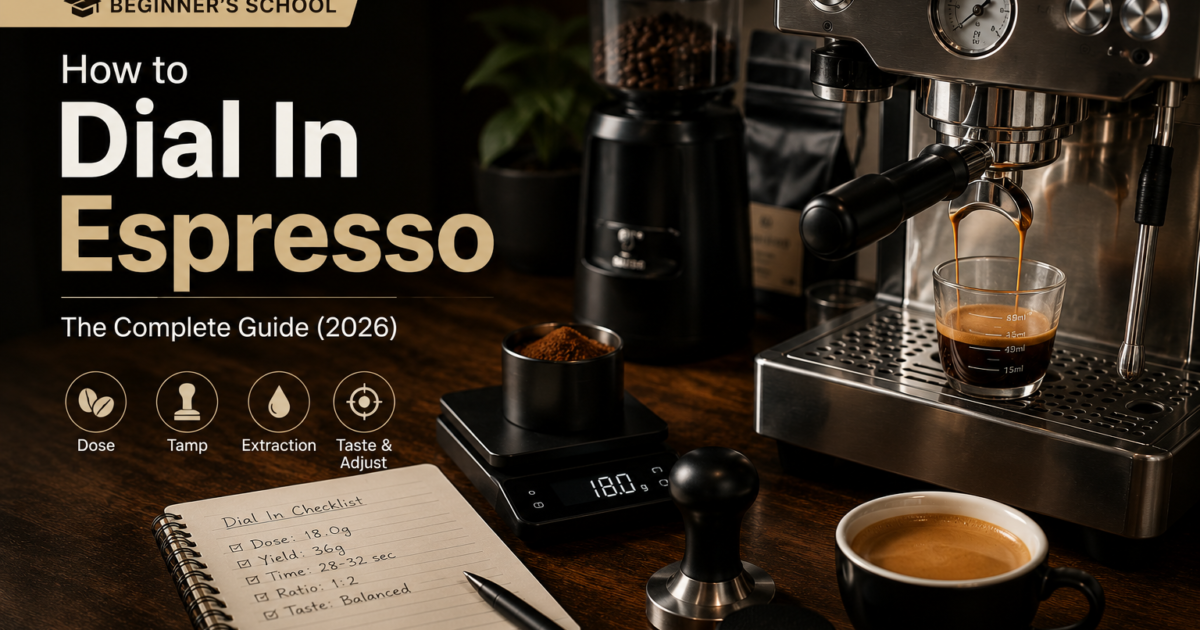
The Golden Ratio: Your Starting Point
The golden ratio for espresso is a 1:2 ratio. That means:
- Dose: 18 grams of ground coffee
- Yield: 36 grams of brewed espresso
- Time: 25-30 seconds
This is your starting point. From here, you’ll adjust based on taste.
| Variable | Standard Target | Your Starting Point |
|---|---|---|
| Dose | 18-20 grams | 18 grams |
| Yield | 36-40 grams | 36 grams |
| Time | 25-30 seconds | 25-30 seconds |
| Ratio | 1:2 | 1:2 (18g dose : 36g yield) |
Step-by-Step Dialing In Process
Step 1: Choose Your Coffee
Start with fresh, quality coffee. For espresso, look for:
- Roast date: 7-14 days off roast
- Roast level: Medium to medium-dark
- Origin: A blend is often more forgiving than a single origin
Read our Beans & Roasts Guide for more information.
Step 2: Weigh Your Dose
Use a scale to weigh 18 grams of coffee beans. Consistency is critical – don’t guess.
Step 3: Grind and Prepare
Grind the coffee into your portafilter. Distribute the grounds evenly and tamp firmly with consistent pressure.
Step 4: Pull the Shot
Lock the portafilter into the group head. Start the shot and time it immediately. Place your scale under the cup and stop the shot at 36 grams.
Step 5: Evaluate the Results
Check three things:
- Time: Did it take 25-30 seconds?
- Yield: Did you get 36 grams?
- Flow: Did the shot flow evenly?
Step 6: Taste and Adjust
Taste the espresso. Ask yourself:
- Sour? Under-extracted – grind finer
- Bitter? Over-extracted – grind coarser
- Thin? Under-extracted – grind finer or increase yield
- Good? You’ve found your dial – stick with it
Key Tip: Always adjust one variable at a time. Changing multiple things at once makes it impossible to know what worked.
Visual Guide: Dialing In Flowchart
┌─────────────────────────────────────────────────────────────┐
│                     START HERE                             │
│      18g dose  |  36g yield  |  25-30 sec                 │
└─────────────────────────┬───────────────────────────────────┘
                          │
                          ▼
                   ┌─────────────┐
                   │  PULL SHOT  │
                   └─────────────┘
                          │
                          ▼
              ┌───────────────────────┐
              │     TASTE IT          │
              │  Sour? Bitter? Good?  │
              └───────────┬───────────┘
                          │
           ┌──────────────┼──────────────┐
           │              │              │
           ▼              ▼              ▼
    ┌────────────┐ ┌────────────┐ ┌────────────┐
    │   SOUR     │ │  BITTER    │ │   GOOD     │
    │(Under-ext) │ │(Over-ext)  │ │ (Perfect)  │
    └─────┬──────┘ └──────┬─────┘ └──────┬─────┘
          │               │              │
          ▼               ▼              ▼
    ┌────────────┐ ┌────────────┐ ┌────────────┐
    │ GRIND      │ │ GRIND      │ │  KEEP      │
    │ FINER      │ │ COARSER    │ │ DIALING    │
    └────────────┘ └────────────┘ └────────────┘
Troubleshooting Common Problems
| Problem | Likely Cause | Solution |
|---|---|---|
| Sour taste | Under-extraction (too coarse) | Grind finer |
| Bitter taste | Over-extraction (too fine) | Grind coarser |
| Thin body | Under-extraction | Grind finer or increase dose |
| Harsh acidity | Under-extraction | Grind finer or increase yield |
| Flat taste | Over-extraction | Grind coarser or decrease yield |
| No crema | Stale beans | Use fresher beans |
| Shot runs too fast | Grind too coarse | Grind finer |
| Shot runs too slow | Grind too fine | Grind coarser |
| Channeling | Uneven distribution or tamping | Improve distribution and tamp evenly |
Advanced Dialing In Techniques
1. Adjusting Yield Instead of Grind
Sometimes it’s easier to adjust the yield rather than the grind. If your shot is 25 seconds but tastes sour, try increasing the yield to 40g. If it’s 25 seconds but tastes bitter, try decreasing the yield to 30g.
2. Temperature Adjustment
Light roasts often benefit from higher temperatures (200-205°F). Dark roasts benefit from lower temperatures (195-200°F). If your machine has PID control, experiment with temperature.
3. Pre-Infusion
Pre-infusion is a low-pressure wetting phase that can improve extraction, especially for light roasts. If your machine supports it, try pre-infusing for 3-5 seconds.
4. When to Change Dose
We recommend keeping dose consistent (18g) and adjusting grind and yield. Only change dose if you need to significantly change shot volume or strength.
Practical Exercise: The “Salami Shot”
The salami shot is a great exercise for understanding extraction. Here’s how to do it:
- Set up your espresso machine as normal.
- Place several cups under the portafilter.
- Change cups every 5-7 seconds during the extraction.
- Taste each cup individually.
What you’ll notice:
- First portion: Sour, acidic
- Middle portion: Sweet, balanced
- Last portion: Bitter, over-extracted
This exercise helps you understand how extraction changes over time – and why the 1:2 ratio works.
Frequently Asked Questions
How long does dialing in take?
With practice, you can dial in a new coffee in 2-4 shots. Don’t be discouraged if it takes more – even professionals need a few attempts.
Do I need a scale?
Yes. A scale is essential for consistency. Measuring by weight is far more accurate than measuring by volume.
What’s the best grind size for espresso?
There’s no one-size-fits-all answer. The ideal grind size is the one that gives you a 25-30 second extraction with a 1:2 ratio. This will vary by coffee, machine, and grinder.
Why does my espresso taste sour?
Sour espresso usually means under-extraction. Try grinding finer, increasing your dose, or increasing your yield.
Why does my espresso taste bitter?
Bitter espresso usually means over-extraction. Try grinding coarser, decreasing your dose, or decreasing your yield.
Can I use pre-ground coffee?
We don’t recommend it. Pre-ground coffee goes stale quickly and doesn’t allow you to adjust the grind size for dialing in.
What’s the difference between dark and light roast for dialing in?
Light roasts are denser and harder to extract. They often need a finer grind and higher temperature. Dark roasts are more porous and extract more easily – they may need a coarser grind and lower temperature.
Conclusion: Dialing In Is a Skill You Can Master
Dialing in espresso is one of the most rewarding skills you’ll learn as a home barista. Yes, it takes practice. Yes, you’ll waste some coffee. But the payoff – consistently delicious espresso – is worth it.
Remember the process:
- Start with the golden ratio – 18g dose, 36g yield, 25-30 seconds
- Adjust one variable at a time – usually grind size first
- Taste and evaluate – sour? bitter? good?
- Repeat – until you find the sweet spot
With practice, you’ll develop the intuition to dial in any coffee in just a few shots. And once you do, you’ll never look back.
For more beginner-friendly guides, check out our Beginner’s School or our Coffee Grinders Guide.
External Resources (DoFollow):
Specialty Coffee Association (SCA)
Home-Barista Forums
This espresso dialing guide was developed by our team of SCA-accredited baristas and coffee educators with over 10 years of teaching experience. We’ve helped thousands of beginners master this essential skill – no shortcuts, no sponsorships.
Last Updated:
Some links on this site are affiliate links. We may earn a small commission at no extra cost to you.