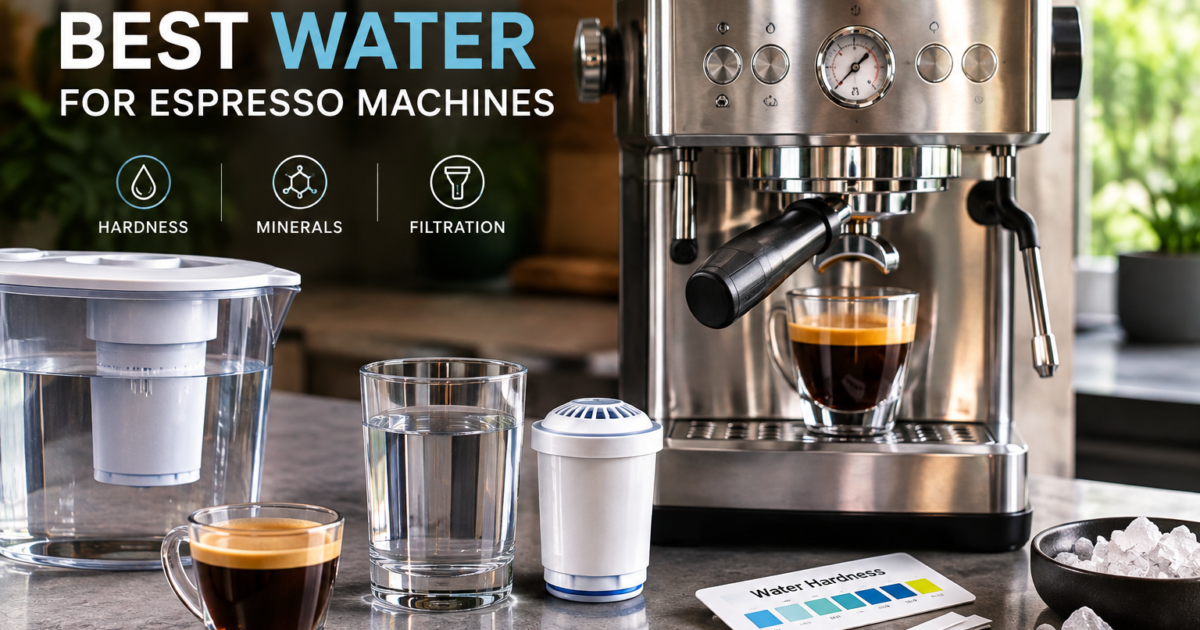
Best Water for Espresso Machines: Hardness, Minerals & Filtration
Learn what water is best for espresso machines, how hardness and minerals affect coffee, and how filtration can reduce scale.
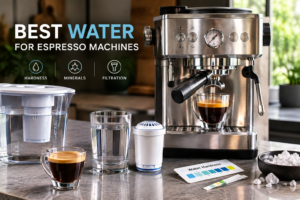
Finding the best water for espresso machines isn’t as simple as grabbing whatever bottled water is on sale, and it isn’t as simple as assuming filtered is always better either. Espresso machine water needs a specific balance: enough minerals to extract flavor properly, but not so many that they build up inside your boiler and group head. Get it wrong in either direction and you’ll notice it — either in your cup or in your machine’s lifespan.
What’s in this guide
Why Espresso Machine Water Matters So Much
Espresso is roughly 98% water, so whatever is dissolved in that water directly shapes what ends up in your cup. Beyond flavor, espresso machine water also determines how quickly scale builds up inside your boiler, group head, and internal tubing — which is why the water you use affects both your shot quality today and your machine’s lifespan down the road.
Understanding Espresso Water Hardness
Espresso water hardness refers to the concentration of dissolved calcium and magnesium in your water. It’s usually measured in grains per gallon (GPG) or parts per million (ppm), and it’s the single biggest factor in how often you’ll need to descale.
| Hardness Level | Typical Range | What It Means for Your Machine |
|---|---|---|
| Soft | 0-60 ppm | Low scale risk, but can under-extract if too soft |
| Medium | 61-120 ppm | Generally the sweet spot for both flavor and machine health |
| Hard | 121-180 ppm | Noticeably faster scale buildup, more frequent descaling needed |
| Very Hard | 180+ ppm | Significant scale risk; filtration strongly recommended |
Not sure where your water falls, or how often to descale because of it? Get a personalized schedule based on your hardness level.
Minerals: Too Few, Too Many, Just Right
It’s a common assumption that purer water is automatically better water for espresso, but that’s not quite right. Calcium and magnesium ions actually help extract flavor compounds from coffee — water that’s too pure (like distilled water) extracts flat, under-developed shots, even though it produces zero scale.
On the other end, water with too much mineral content extracts harsh, unbalanced flavors and accelerates scale buildup significantly. The best water for espresso machines sits in the middle: enough mineral content to extract properly, not so much that it damages your equipment.
Comparing Your Water Options
Tap Water
Fine if your local water is soft to medium hardness, paired with regular descaling. Risky without filtration if your area has hard or very hard water.
Bottled Water
Convenient, but inconsistent — some brands are far too pure (distilled/reverse osmosis) and others are surprisingly high in minerals. Check the label’s mineral content rather than assuming.
Filtered Water
The most reliable middle-ground option for most people — reduces the extremes of hard tap water without stripping out minerals entirely, especially with a filter designed specifically for espresso machines.
Remineralized Water
Distilled or reverse-osmosis water with mineral packets added back in specific ratios. The most precise option, popular with serious enthusiasts, but requires more effort and measuring than most casual users want.
How Filtration Helps
An inline filter designed for espresso machine water reduces hardness-causing minerals to a target range without eliminating them completely, which is exactly the balance you want. Many prosumer and commercial-style machines even have a dedicated filter attachment point built in for this reason.
Filtration doesn’t replace regular maintenance — you’ll still need to descale and backflush on a normal schedule — but it significantly slows down how quickly scale accumulates, which means less frequent descaling and a longer effective lifespan for your boiler and internals.
Our Recommendation
For most home users, the best water for espresso machines is filtered tap water using a filter rated for espresso equipment, combined with a descaling schedule matched to your local hardness. If you want to go further, remineralized water gives you the most control, but it’s genuinely more effort than most people want for daily use. Avoid straight distilled or reverse-osmosis water on its own — it’s the one option that actively works against good extraction.
Keep Your Machine Running Well
Good water for espresso is only half the equation — pairing it with a consistent maintenance routine is what actually protects your machine long-term. See our full maintenance schedule and use the descaling calculator to set the right interval for your water.
Frequently Asked Questions
Is bottled water good for espresso machines?
Some bottled waters work well, but not all. Water that’s too pure (like distilled or reverse-osmosis bottled water) lacks the minerals needed for good extraction and can actually corrode certain machine parts over time. Look for bottled water with a moderate, labeled mineral content rather than assuming “purified” is automatically best.
Can I use tap water in my espresso machine?
It depends entirely on your local water hardness. Soft to moderately hard tap water is often fine, especially with regular descaling. Hard or very hard tap water will accelerate scale buildup significantly and is generally not recommended without filtration.
Does water quality really affect espresso taste?
Yes, significantly. Since espresso is roughly 98% water, mineral content directly affects extraction and flavor. Water with too few minerals extracts flat, under-developed flavor; water with too many minerals can extract harsh or unbalanced flavor, in addition to accelerating scale buildup.
What’s the best simple solution if I don’t want to test my water?
A basic inline filter designed for espresso machines is the most reliable low-effort option. It won’t be as precise as remineralized water made from a specific recipe, but it removes the extremes of overly hard or overly soft water without requiring you to test or mix anything.
Water hardness ranges referenced from general guidance published by the U.S. Geological Survey and brewing water standards from the Specialty Coffee Association.
Some links on this site are affiliate links. We may earn a small commission at no extra cost to you.