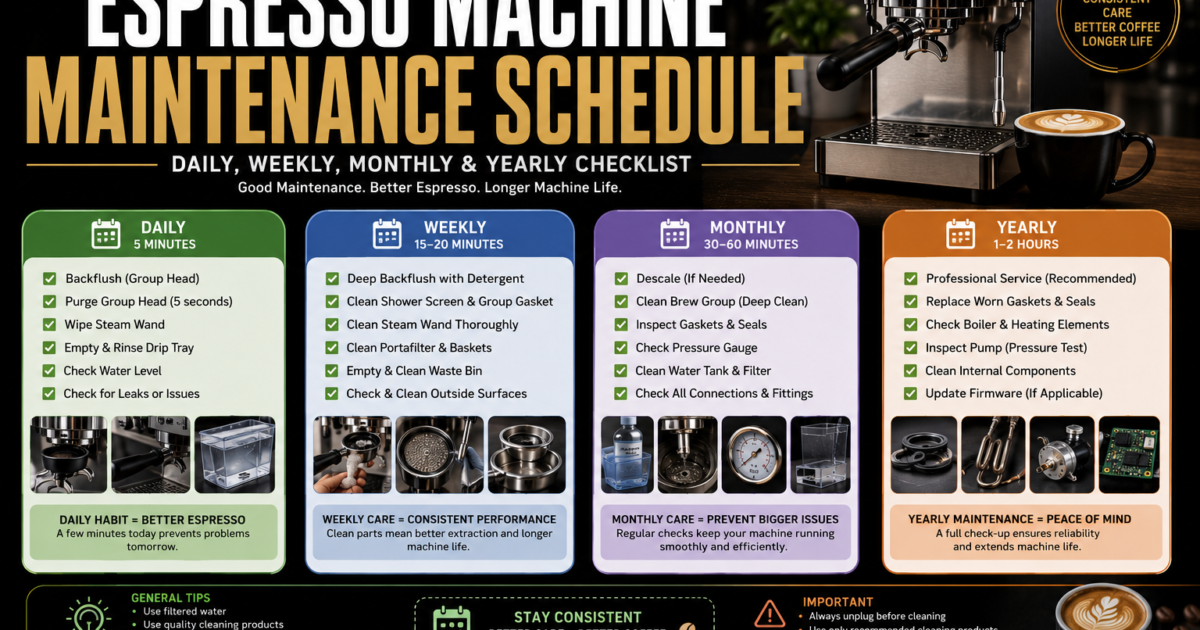
Espresso Machine Maintenance Schedule: Daily, Weekly, Monthly & Yearly Checklist
Introduction
Most espresso machine failures are not manufacturing defects. They’re maintenance deficits. A machine that costs $3,000 will die just as surely as a $300 one if you never clean it. The difference between a machine that lasts 3 years and one that lasts 15 is rarely the build quality—it’s the owner’s discipline with a simple routine.
This espresso machine maintenance schedule is the exact protocol we follow across every machine in our test kitchen, from the Gaggia Classic Pro to the La Marzocco lineup and the Profitec Pro 600. It’s not theoretical. It’s the distillation of hundreds of hours of use, several avoidable repairs, and direct guidance from manufacturer service departments. None of these tasks require mechanical skill. They require consistency.
For the deep dives on specific procedures, we have dedicated guides on how to descale an espresso machine and how to backflush an espresso machine with full step-by-step instructions. This page is your master schedule—the what and when. Those pages are the how.
Daily Tasks Daily
These are non-negotiable. They take under 2 minutes combined and prevent 90% of the issues that degrade shot quality over time. Do these after every session, or at minimum once per day if you pull shots throughout.
☀️ Daily Maintenance Checklist
- Purge the steam wand immediately after every use. Wipe with a damp cloth, then open the steam valve for 1 second to blow out any milk residue inside the tip. Dried milk inside a steam wand is a bacterial hazard and blocks steam flow.
- Flush the group head after every shot. Run water through the group for 2-3 seconds with no portafilter attached. This clears loose coffee grounds and oils from the shower screen before they bake on.
- Wipe the shower screen and group gasket. After flushing, wipe the shower screen and the rubber gasket groove with a clean, dry cloth. Coffee grounds trapped in the gasket groove cause portafilter sealing problems and premature gasket wear.
- Empty and rinse the drip tray. Standing water in the drip tray grows mold quickly, especially with coffee residue. Empty it, rinse with hot water, and wipe dry. On machines with a drip tray grate, rinse that too.
- Water backflush (machines with 3-way solenoid valve only). Insert the blind basket, run the pump for 5 seconds, stop, let the solenoid discharge. Repeat 3-5 times. This clears fresh coffee oils from the group head before they oxidize. Full instructions in our backflushing guide.
- Check water reservoir level and refill. Don’t let the pump run dry. Refill with fresh, filtered water. Do not top off old water—empty and refill completely if the water has been sitting for more than a day.
Weekly Tasks Weekly
These take about 10-15 minutes. Schedule them for the same day each week—Sunday morning after your last shot works well. The chemical backflush is the most important task here.
📅 Weekly Maintenance Checklist
- Chemical backflush (machines with 3-way solenoid valve). Use espresso cleaning detergent (Cafiza, Puly Caff) in the blind basket. Pulse 5 times: 10 seconds on, 5 seconds off, with a 30-second detergent dwell before pulsing. Flush thoroughly with clean water afterward—at least 5-7 water-only backflush cycles until no foam or detergent smell remains. See our complete backflush guide for the full step-by-step.
- Soak the portafilter and baskets. Remove the filter basket from the portafilter. Soak both in a solution of hot water and espresso detergent for 15 minutes. Scrub with a nylon brush to remove baked-on coffee residue. Rinse thoroughly. Coffee oils accumulate in the basket holes and spouts, not just the machine.
- Wipe down the entire machine exterior. Use a damp microfiber cloth. Pay attention to the area behind the drip tray, under the group head, and around the control panel. Coffee splatter and dust accumulate in crevices. For stainless steel machines, a dedicated stainless cleaner prevents water spot etching.
- Clean the steam wand tip. Unscrew the steam tip (if removable) and soak it in hot water. Use a pin or steam tip cleaning tool to clear any blocked holes. Even a single clogged hole significantly reduces steam performance.
- Check the water filter (if equipped). Most in-tank water softeners last 4-8 weeks depending on usage and water hardness. If your filter has a date indicator or you track installation dates, check whether it’s due for replacement.
Monthly Tasks Monthly
These tasks go slightly deeper—addressing components that degrade slowly and aren’t visible during daily use. Budget 20-30 minutes.
📆 Monthly Maintenance Checklist
- Descale the machine (frequency depends on water hardness). For moderately hard water, monthly descaling is appropriate. Use a manufacturer-approved descaler for your boiler material—aluminum-safe for Gaggia boilers, standard Dezcal or Durgol for brass and stainless steel. Full instructions in our descaling guide. If you use remineralized RO water, you can extend this to quarterly or longer.
- Remove and inspect the shower screen. Unscrew the shower screen (most are held by a single central screw). Look at the back side. If it’s caked with dark, hardened coffee residue that doesn’t wipe off, it needs a chemical soak or replacement. Shower screens cost $5-15 and should be replaced annually regardless.
- Clean the dispersion block. Behind the shower screen is the dispersion block (also called a jet breaker or water distributor). Wipe it clean. If water isn’t flowing evenly through all holes, soak it in detergent.
- Lubricate the group gasket (E61 group heads). On E61 machines (ECM, Profitec, Rocket, Lelit), apply a thin layer of Molykote 111 food-grade silicone grease to the group gasket. This prevents the gasket from drying out, cracking, and causing portafilter sealing issues. Do not over-lubricate—a thin film is enough.
- Inspect all seals and O-rings. Look for any signs of cracking, hardening, or mineral buildup around visible seals. This includes the group gasket, steam wand O-rings, and water reservoir connections. Catching a failing seal early prevents water leaks that damage electronics.
- Replace the in-tank water filter (if equipped). Most softener cartridges are rated for 4-6 weeks. A saturated filter stops softening and can leach concentrated minerals back into the water. Mark your calendar or set a recurring reminder.
Annual & Bi-Annual Tasks Yearly
These are deeper maintenance items that don’t need frequent attention but are critical for long-term reliability. Some are DIY-friendly. Others warrant professional service.
🔧 Annual & Bi-Annual Maintenance Checklist
- Replace the group gasket (every 6-12 months). The rubber gasket that seals the portafilter compresses and hardens over time. When you have to crank the portafilter further to the right to get a seal, the gasket is worn. Replacement takes 5 minutes with a flathead screwdriver or gasket pick. Gaskets cost $5-10.
- Replace the shower screen (annually). Even with regular cleaning, the fine mesh accumulates residue that affects water dispersion. A new shower screen noticeably improves shot evenness. At $5-15, it’s the cheapest performance upgrade you can make.
- Deep clean or replace the steam wand assembly. Over a year, milk residue builds up inside the wand beyond what purging removes. Disassemble the wand and soak all components in detergent. Replace any O-rings that show wear.
- Inspect the vacuum breaker valve (every 1-2 years). The vacuum breaker is the small valve on top of the steam boiler that hisses during warm-up. Over time, the internal O-ring degrades and the valve leaks steam continuously. A replacement valve costs $15-25 and prevents steam boiler water loss.
- Service the pump (every 2-3 years or as needed). Vibratory pumps lose pressure output over time. If your brew pressure has dropped and descaling doesn’t restore it, the pump may need replacement. This is a $40-60 part and a 30-minute DIY job on most machines. Rotary pumps last longer—typically 5-10 years—but should be checked for noise and vibration changes.
- Professional boiler inspection (every 2-3 years for high-end machines). For machines like the La Marzocco GS3 or Linea Mini with large commercial boilers, an authorized technician should inspect boiler condition, pressurestat calibration, and safety valve function. This is not a DIY task on plumbed-in, high-volume machines.
- Replace safety and check valves (every 3-5 years). The safety valve (pressure relief) and check valves (prevent backflow) are critical safety components. They fatigue with heat cycling. Manufacturers specify replacement intervals—follow them. A failed safety valve can cause dangerous over-pressurization.
How the Schedule Changes by Machine Type
☕ Single Boiler (Gaggia Classic Pro, Rancilio Silvia, ECM Casa V)
Single boilers are simple and have fewer failure points, but they require more frequent descaling because the smaller boiler volume concentrates mineral buildup faster. The Gaggia Classic Pro’s aluminum boiler demands aluminum-safe descaler specifically. Backflushing is identical to dual boilers. Most single boilers lack an in-tank water filter, so descaling schedule depends entirely on your tap water. Budget for a new group gasket every 6 months—single boiler gaskets tend to wear faster because owners often over-tighten the portafilter to compensate for lighter machine weight. Our Gaggia Classic Pro review covers model-specific quirks.
🔥 Dual Boiler (Profitec Pro 600, Lelit Bianca, ECM Synchronika, Breville Dual Boiler)
Dual boilers have two separate water circuits that both need descaling. The steam boiler is larger and holds more water, so mineral accumulation is slower, but thorough flushing takes longer. E61 group heads (Profitec, ECM, Lelit, Rocket) require monthly cam lever lubrication—a step single boiler owners skip entirely. The E61 group also benefits from cleaning the mushroom valve annually. Rotary pump machines (common in this tier) need pump oil checks every 2-3 years. The Profitec Pro 600 is our reference dual boiler for maintenance testing.
💧 Plumbed-In Machines (La Marzocco GS3, high-end commercial)
Plumbed machines eliminate the water reservoir but introduce in-line filtration systems that need their own maintenance. Pre-filters and softeners must be changed on schedule—typically every 6-12 months depending on water volume. Plumbed machines are not designed for DIY descaling. La Marzocco specifically recommends against owner-performed descaling on the Linea Mini and GS3. Instead, use properly formulated water from day one and have a technician perform boiler maintenance every 2-3 years. The drain line also needs periodic cleaning to prevent biofilm buildup. See our La Marzocco lineup guide for brand-specific protocols.
Summary Checklist
This is the at-a-glance reference. Print it, stick it on the inside of a cabinet door, and check off tasks as you go. Consistency matters more than perfection.
| Frequency | Task | Time |
|---|---|---|
| After every shot | Group head flush, steam wand purge & wipe | 15 sec |
| Daily | Water backflush (3-5 cycles), drip tray empty, reservoir refill | 2 min |
| Weekly | Chemical backflush, portafilter soak, exterior clean, steam tip clean | 15 min |
| Monthly | Descale, shower screen inspection, group gasket lube (E61), water filter replacement | 30 min |
| 6-12 Months | Replace group gasket, replace shower screen | 10 min |
| Annually | Steam wand deep clean, vacuum breaker check | 30 min |
| 2-3 Years | Pump service, professional boiler inspection (high-end machines) | 1-2 hrs |
| 3-5 Years | Safety valve replacement, check valve replacement | Service call |
📋 Printable Version
Copy the table above into a document, print it, and keep it near your machine. Checking boxes builds the habit faster than trying to remember. Within a month, the daily tasks will be automatic.
Frequently Asked Questions
Q: What’s the single most important maintenance task?
A: The daily water backflush. It prevents the cascade of problems that start with accumulated coffee oils in the group head. Everything else can be recovered from. A clogged solenoid valve from months of no backflushing often requires professional repair. If you do nothing else, do this.
Q: Can I combine the descaling and chemical backflush into one session?
A: Yes, and it’s efficient to do them together monthly. Descale first (flushing solution through the boilers and circuits), then do the chemical backflush at the group head afterward. Do not mix descaling solution and backflush detergent—they’re chemically different products with different purposes. Complete one process, flush thoroughly, then start the other.
Q: What happens if I skip a week of maintenance?
A: One missed week won’t destroy your machine. Two missed weeks, you’ll start tasting the difference—a persistent bitterness from rancid oils. A month of neglect, and you’re risking a clogged solenoid valve. The schedule is preventative. A single lapse is recoverable. A pattern of lapses shortens machine life measurably.
Q: Do super-automatic machines need the same maintenance schedule?
A: No. Super-automatics have different internal mechanisms—brewing units instead of group heads, and often automated cleaning cycles. Follow your manufacturer’s schedule. The principles are similar (coffee oils must be removed, water paths must be descaled), but the procedures are machine-specific and often automated.
Q: Where can I find model-specific maintenance instructions?
A: Your machine’s user manual is the first stop—it includes the manufacturer’s recommended schedule and approved cleaning products. For community-driven guidance, owner forums for Gaggia, Rancilio, and La Marzocco have extensive documentation. Our individual machine reviews (linked throughout this guide) include model-specific maintenance notes drawn from hands-on testing.
External Resources: For manufacturer-specific maintenance intervals and approved cleaning product lists, refer to Urnex for Cafiza compatibility and Speciality Coffee Association for water quality standards that reduce maintenance frequency.
Some links on this site are affiliate links. We may earn a small commission at no extra cost to you.