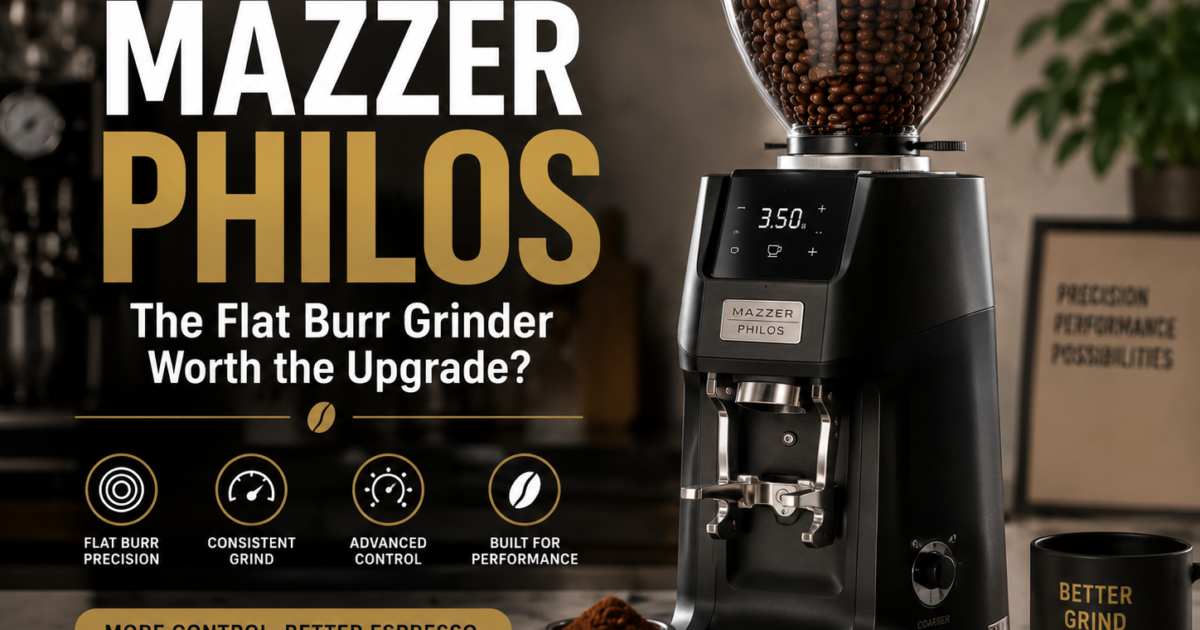
Mazzer Philos Review: The Flat Burr Grinder Worth the Upgrade? (2026)

Introduction
Mazzer doesn’t chase trends. For over 70 years, the Italian manufacturer built commercial grinders that outlasted leases, baristas, and occasionally the cafes themselves. Then the single-dose movement happened, and Mazzer watched from the sidelines while boutique brands ate their lunch. The Mazzer Philos is the retaliation—a ground-up redesign that ditches the hopper, the doser, and the stubbornness. This is not a modified Super Jolly. It’s a statement.
This Mazzer Philos review compares the Philos’s published specifications with published reviews and with the Lagom P64 and Mazzer Mini G, so you can judge whether its single-dose design and worm-gear adjustment suit your workflow.
If you’re still navigating burr geometry fundamentals, our guide to burr vs blade grinders is essential reading before making this investment.
How This Review Was Put Together
This review is based on the Philos’s published specifications (64mm flat burrs, stepless worm-gear dial, single-dose workflow, magnetic chute and dosing cup) and on published reviews, compared with the same information for the Lagom P64 and Mini G. It is not a hands-on test report.
At a Glance: Mazzer Philos Specs
| Feature | Specification |
|---|---|
| Burr Type | 64mm flat (Mazzer I200D or I189D) |
| Grind Adjustment | Stepless, worm-gear driven dial |
| Hopper Capacity | Single-dose only (approx. 40g max) |
| Dosing System | Vertical drop with magnetic anti-static chute |
| Body Material | Die-cast aluminum, powder-coated |
| Weight | 12.3 kg (27.1 lbs) |
| Finish Options | Matte Black, Stainless Steel |
| Intended Use | Serious Home / Cupping Lab |
Design & Build Quality
The Philos is unmistakably Mazzer, yet entirely unlike anything they’ve shipped before. The silhouette is vertical and compact—taller than it is wide—with the motor housing forming a solid column beneath the burr chamber. At 12.3 kg, it’s heavier than the Mini G and feels even denser. Tapping the body produces a dull thud, not a ring. That’s real damping.
The magnetic chute is the headline design win. It snaps into place with a satisfying click and pops off for cleaning without tools. The dosing cup is a heavy, knurled stainless steel piece that sits on a magnetized base, perfectly aligned with the exit chute. No plastic adapters, no 3D-printed aftermarket nonsense. Mazzer finally understood the assignment. The worm-gear adjustment dial sits on the side, marked with clear numerals—not the cryptic micrometrical rings of their commercial line. You can actually read it at a glance.
Grind Performance & Consistency
The Philos uses Mazzer’s 64mm flat burrs (I200D or I189D options). The manufacturer states each Philos is tested for burr parallelism before leaving the factory. Published reviews compare its grind quality with the Mini G and the Lagom P64; check owner reviews for reported side-by-side impressions.
- Particle Distribution: Flat burrs are designed to produce a consistent particle spread for clarity-focused brewing; published reviews discuss how the Philos compares with the Mini G.
- Filter Range: The worm-gear dial is designed to make moving between espresso and pour-over repeatable. The flat burr geometry suits clean, low-fines grinds for pour-over and batch brew.
- Seasoning Period: New burrs generally need a settling period; follow the manufacturer’s guidance for the Philos rather than treating any single figure as a rule.
Flat burr geometry is a common choice for clarity-focused brewing at this price tier. If you want the technical breakdown, our burr vs blade comparison explains why flat burrs dominate in this price tier.
Workflow & Ease of Use
The Philos is the first Mazzer where single-dosing feels native, not retrofitted. The workflow is: weigh beans in the provided cup, dump into the top funnel, hit the power switch, and watch grinds fall into the magnetic dosing cup below.
- Static: The magnetic anti-static chute is designed to reduce static. A light spritz of water (RDT) is a common owner technique for keeping grinds flowing cleanly.
- Retention: Single-dose flat-burr grinders can retain some grounds in the chute; bellows-style accessories are commonly used by owners to reduce retained grounds. The Philos’s straight vertical drop path is designed to minimize places for grounds to collect; check owner reviews for reported retention.
- Noise: Noise is a common owner-review topic for 64mm flat-burr grinders; check video/owner reviews if noise matters to you.
The only workflow irritation: the power switch is a manual toggle, not automatic. You flip it on, grind, flip it off. At this price, an auto-stop when the hopper empties would be a reasonable expectation. For a full tour of grinder options across all budgets, head to our coffee grinders hub.
Mazzer Philos vs Option-O Lagom P64
At this price point, the Lagom P64 is the benchmark. Both use 64mm flat burrs. Both target the single-dose purist. Here’s how they separate.
| Feature | Mazzer Philos | Lagom P64 |
|---|---|---|
| Burr Options | Mazzer I200D / I189D (proprietary) | SSP Multi-Purpose / Cast / HU |
| Grind Adjustment | Worm-gear stepless dial | Top-mounted stepless collar |
| Motor RPM | ~1400 RPM (geared down) | Variable, 200-1400 RPM |
| Build Material | Die-cast aluminum | CNC-machined aluminum |
| Weight | 12.3 kg | 7.6 kg |
| Price (2026) | ~$1,595 | ~$1,650 |
| Best For | Set-and-forget espresso; Mazzer loyalists | Burr swappers; filter-to-espresso tinkerers |
The Philos matches the P64 on grind quality but takes a different philosophical path: fewer variables, heavier build, less fiddling. Choose your personality. Browse all contenders in our coffee grinders directory.
Maintenance
The Philos is built for a lifetime of easy cleaning, and the design choices reflect that.
- Burr Access: Remove the magnetic chute, unscrew four bolts on the top plate, and the upper burr carrier lifts out cleanly. No recalibration needed on reassembly—the alignment pins set it perfectly every time.
- Chute Cleaning: The magnetic chute slides off in one second. Wipe with a dry brush, snap back on. Total time: under 30 seconds.
- Motor: Sealed commercial motor rated for continuous duty. It won’t overheat during back-to-back shots, unlike some home-focused competitors that need a cooldown after 3-4 grinds.
- Burr Lifespan: Burr lifespan depends on use and maintenance; follow the manufacturer’s guidance for replacement intervals.
Pros and Cons
Pros
- 64mm flat burrs in a purpose-built single-dose design.
- Magnetic chute and dosing cup—zero-tool cleaning.
- Straight-through grind path designed to minimize retention.
- Readable, repeatable worm-gear adjustment dial.
- Commercial motor with no duty cycle limits.
Cons
- Manual power switch—no auto-stop.
- No variable RPM control.
- Proprietary Mazzer burr geometry; check current third-party burr compatibility before buying if burr swapping matters to you.
- Footprint is tall—won’t fit under standard cabinets.
Who Is It For?
The Mazzer Philos is for the home barista who wants laboratory-grade consistency without laboratory-grade complexity. Buy this if you pull mostly espresso, value mechanical longevity above all else, and want a grinder that arrives factory-checked for burr parallelism. The sealed commercial motor is designed for continuous duty, which suits back-to-back grinding.
Skip this if you’re a burr tinkerer who wants to swap between SSP Cast and Unimodal burrs every month. The Philos locks you into Mazzer’s ecosystem. It’s a precision instrument, not a platform. For dark roast milk drink lovers, a conical grinder at half the price will deliver the texture profile you actually prefer. This grinder rewards clarity-focused light and medium roasts.
Final Verdict
This mazzer philos review finds that Mazzer has built a single-dose grinder that doesn’t feel like a retrofit. The Philos is not a compromised commercial machine; it’s a purpose-built precision tool that happens to share DNA with the café tanks. The magnetic chute is a genuinely thoughtful piece of engineering, and the weight and damping give it a refined feel.
The drawbacks—proprietary burrs, manual switch, no variable RPM—are real but intentional. Mazzer made philosophical choices here (hence the name) that prioritize alignment, repeatability, and longevity over user-configurable experimentation. At ~$1,595, it’s expensive — check current retailer price. But it’s also a grinder your grandchildren could use. If you align with its philosophy, this is among the most refined flat-burr grinders Mazzer has made for the home.
Frequently Asked Questions
Q: Does the Mazzer Philos require seasoning?
A: Yes. New burrs generally need a settling period; follow the manufacturer’s guidance for the Philos rather than treating any single figure as a rule.
Q: Can the Philos grind for filter coffee?
A: Absolutely. The worm-gear dial makes moving between espresso and pour-over repeatable. The flat burr geometry produces clean, low-fines grinds that work beautifully for V60 and batch brew.
Q: Is the Philos compatible with SSP burrs?
A: The Philos uses Mazzer’s proprietary burr geometry (I200D/I189D). Third-party burr compatibility can change over time — check current sources before buying if burr swapping matters to you.
Q: How noisy is the Mazzer Philos?
A: Noise is a common owner-review topic for 64mm flat-burr grinders; check video/owner reviews if noise matters to you.
External Resources: For independent burr alignment verification methods, refer to the Speciality Coffee Association technical standards. Additional particle distribution testing methodologies can be found at Barista Hustle.
For a comparison with Mazzer’s other single-dose grinder, see our Mini G vs Philos breakdown.
Some links on this site are affiliate links. We may earn a small commission at no extra cost to you.